
.jpg)
Case Series/Study
Lymphedematous legs have dermatitis, or highly inflamed skin, which is often found in edematous flaps, lobes, and skin folds, and is a result of irritation from trapped perspiration, lymphorrhea (leakage of protein rich fluid), and wound exudate from minute skin breakdown hidden within intertriginous areas. Dermatitis can present as red, pruritic, dry, flaky skin. While the edema aspect of lymphedema can be well controlled with effective compression, the inflammation of the skin is an undertreated aspect of lymphedema care. We describe here the use of a pure hypochlorous acid (pHA) based antimicrobial wound gel in the management of inflamed skin and skin folds of lymphedema patients since in busy wound/vein/lymphedema clinics.
Methods: We describe here the results from 26 patients who were diagnosed with acute dermatitis associated with lymphedema, but had no full thickness wounds present. We applied the gel to the skin folds liberally, applying it deep within the folds. Post application, the legs were wrapped with a Dual Compression System (DCS)** product, which we regularly use to control lymphedema. We report skin improvement results concurrent with lymphedema control with compression. Measurements at calf, ankle, and midfoot were taken on Day 1 and for each subsequent follow-up visit over the course of 4-6 weeks. Measurements were taken at the same anatomical and numerical landmarks unique for each patient for each visits. Patient pain level was assessed at each visit via the pain visual analogue scale.
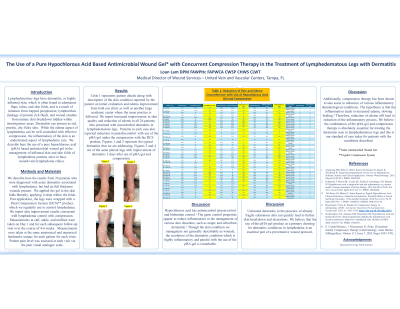
Results: Table 1 represents patient details along with description of the skin condition and edema improvement from both our clinic as well as another large academic center where the same practice is followed. We report increased improvement in skin quality and reduction of edema in all 26 patients who presented with uncontrolled dermatitis in lymphedematous legs. Patients in each case also reported reduction in pain/discomfort with use of the pHA-gel under the compression with the DCS product.
Discussion: Though the skin condition we treated are not generally describable as wounds, the resolution of the dermatitis condition which is highly inflammatory and painful with the use of the pHA-gel is remarkable. Untreated dermatitis in the presence of already fragile edematous skin can quickly lead to further skin breakdown and ulcerations. We believe that the use of this pHA-gel product as a primary dressing for dermatitis conditions in lymphedema is an essential part of a preventative wound protocol.