
.jpg)
Case Series/Study
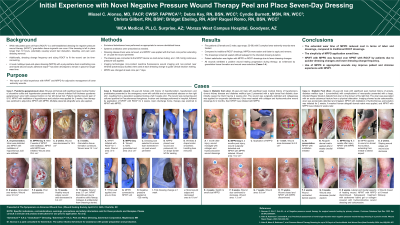
While reticulated open cell foam (ROCF) is a well-established dressing for negative pressure wound therapy (NPWT),1,2 granulation tissue ingrowth can occur if the dressing is left in place longer than 72 hours, potentially causing wound bed disruption, bleeding, and pain upon dressing removal. Additionally, dressing change frequency and sizing the foam to fit the wound can be time-consuming. A novel encapsulated peel-and-place dressing with a polyurethane foam manifolding core and hybrid silicone-acrylic adhesive drape3 has been developed to remain in place for longer wear time. We report our initial experience with NPWT and the peel and place dressing.
Methods:
Excisional debridement was performed as appropriate to remove devitalized tissue. Antibiotics were prescribed as needed. Dressing release liners were removed, and the peel and place dressing was applied with foam core portion extending ≥1 cm past the wound perimeter. The dressing was connected to the NPWT device via multi-lumen tubing, and -125 mmHg continuous pressure was applied. Peel and place dressings were changed at least once per 7 days.
Results:
Four patients (2 female and 2 male; age range: 23-69) with 6 complex lower extremity wounds were treated. Compared to traditional ROCF dressings, peel and place dressings were easier and faster to apply and remove. The dressings remained sealed without leakage for the intended dressing duration. Patient satisfaction was higher with peel and place dressings due to fewer dressing changes. All wounds exhibited a positive wound healing progression during therapy, as evidenced by granulation tissue formation, reduction in wound dimensions, and epithelialization.
Discussion:
The extended wear time of the peel and place dressing reduced cost and application time, compared to traditional ROCF dressings. The simplicity of peel and place dressing application also saved time. NPWT with the peel and place dressing was favored over NPWT with ROCF by patients due to quicker dressing changes and lower dressing change frequency. Use of peel and place dressings in appropriate wounds may improve patient and clinician experience with NPWT.