
.jpg)
Evidence-Based Practice
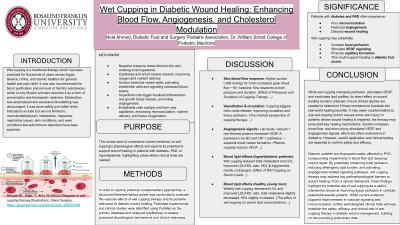
Wound healing in patients with diabetes presents a significant clinical challenge due to impaired blood supply, endothelial dysfunction, and a high prevalence of peripheral vascular disease (PVD), often resulting in chronic, non-healing wounds. Identifying therapies that improve vascular function and tissue perfusion remains a priority in wound care practice, particularly for patients with wound complications. One such therapy is wet-cupping, which is a traditional remedy that has been practiced for ages. Wet cupping therapy involves applying a vacuum cup to the skin followed by superficial skin incisions to draw a small volume of blood by creating negative pressure, leading to localized mechanical stress and hypoxic conditions at the treatment site. It is believed to provide health benefits by removing stagnant blood, reducing cholesterol levels, and increasing blood flow.
Methods: In order to explore potential complementary approaches, a structured literature-based review was conducted to evaluate the vascular effects of wet cupping therapy and its possible relevance to diabetic wound healing. Published experimental and clinical studies were identified using PubMed as the primary database and analyzed qualitatively to assess proposed physiological mechanisms and clinical relevance.
Results: Experimental evidence suggests that mechanical stress and localized hypoxia induced by plasma cupping can activate hypoxia-inducible factor-1 (HIF-1) signaling and upregulate vascular endothelial growth factor (VEGF), a key mediator of angiogenesis, providing biological plausibility for new blood vessel formation. Controlled physiological studies demonstrated significant increases in local skin blood flow at cupping sites, indicating improved microcirculatory perfusion. Adequate perfusion is critical for oxygen delivery, nutrient transport, immune cell recruitment, and extracellular matrix formation. Additionally, multiple clinical studies reported significant reductions in low-density lipoprotein (LDL) cholesterol, which may indirectly improve vascular patency and tissue perfusion, particularly in patients with diabetes and hyperlipidemia.
Discussion:
Diabetic patients are disproportionately affected by PVD, compounding impairments in blood flow and delaying wound repair. By potentially enhancing local perfusion, reducing atherogenic lipid burden, and activating angiogenesis-related signaling pathways, wet cupping therapy may address key pathophysiological barriers to wound healing. From a clinical standpoint, these findings highlight the potential role of wet cupping as a useful intervention aimed at improving tissue perfusion in carefully selected/screened patients. While current evidence supports improvements in vascular signaling and microcirculation, further well-designed clinical trials will help establish the safety, efficacy, and clinical role of wet cupping therapy in diabetic wound management, building on the promising preliminary data.