
.jpg)
Clinical Research
AUP1602-C is a Microbial Vector used for Gene Therapy (MVGT) which has been shown to modulate inflammation, stimulate tissue repair, and restore healing in patients with non-healing diabetic foot ulcers (DFU)1,2. Safety and efficacy of multi-target MVGT AUP1602-C in chronic DFUs has been evaluated in a multi-center, randomized, controlled Phase 2 trial.
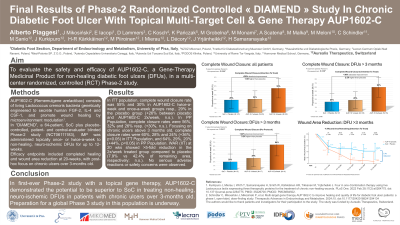
Methods: AUP1602-C (INN: Rememulgene arelactibac) consists of living Lactococcus cremoris bacteria genetically engineered to secrete human Fibroblast 2 (h-FGF-2), Interleukin 4 (h-IL-4) and Colony Stimulating Factor 1 (h-CSF-1), and promote wound healing by microenvironment modulation1. Following a successful Phase-1 study (NCT04281992 / EudraCT 2018-003415-22)2, safety and efficacy AUP1602-C were evaluated in a 64-patient, standard-of-care (SoC) plus placebo-controlled patient and central-evaluator blinded, Phase-2 “DIAMEND” study (NCT06111183 / EU CT 2022-502048-10-00). DIAMEND study was conducted in 10 clinical centers in Germany, Italy and Poland. AUP1602-C was administered topically once- or twice-a-week to non-healing, neuro-ischemic DFUs until complete wound closure or maximum for 12-weeks, along with SoC, provided according to IWGDF guidelines. Efficacy endpoints included completed healing and wound area reduction at 20-weeks, with post-hoc focus on chronic ulcers over 3-months old.
Results: In Intention-To-Treat (ITT) population, complete wound closure rate was 55% and 30% in AUP1602-C twice-a-week and once-a-week groups respectively, and 29% in the placebo group (+26% between placebo and AUP1602-C twice a week, p >0.05). In Per Protocol Population (PP), complete closure rates were 56%, 32% and 26% respectively (+30%, p >0.05). Focusing on chronic ulcers above 3 months old, complete closure rates were 60%, 28% and 24% (+36%, p≤0.05, statistically significant) in ITT Population, and 64%, 29%, 20% (+44%, p≤0.05, statistically significant) in PP Population. No serious adverse reactions or safety concerns related to AUP1602-C were observed.
Discussion: In first-ever Phase-2 study with a topical gene therapy, AUP1602-C demonstrated the potential to be superior to SoC in treating non-healing, neuro-ischemic DFUs in patients with chronic ulcers over 3-months old. Preparation for a global pivotal study in this target population is under way.