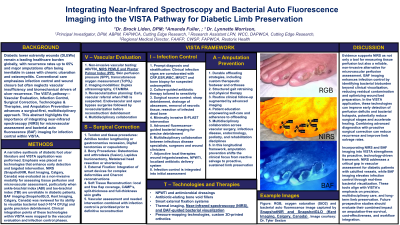
Introduction: Diabetic lower extremity wounds (DLEWs) remain a leading healthcare burden globally, with recurrence rates up to 65% and major amputations often being inevitable in cases with chronic ulceration and osteomyelitis. Conventional care emphasizes infection control and wound closure but often neglects vascular insufficiency and biomechanical drivers of ulcer recurrence. The VISTA pathway—Vascular Evaluation, Infection Control, Surgical Correction, Technologies & Therapies, and Amputation Prevention—advances a surgical-first, multidisciplinary approach. This abstract highlights the importance of integrating near-infrared spectroscopy (NIRS) for microvascular assessment and bacterial auto fluorescence (BAF) imaging for infection control within VISTA.
Methods: Diabetic lower extremity wounds (DLEWs) remain a leading healthcare burden globally, with recurrence rates up to 65% and major amputations often being inevitable in cases with chronic ulceration and osteomyelitis. Conventional care emphasizes infection control and wound closure but often neglects vascular insufficiency and biomechanical drivers of ulcer recurrence. The VISTA pathway—Vascular Evaluation, Infection Control, Surgical Correction, Technologies & Therapies, and Amputation Prevention—advances a surgical-first, multidisciplinary approach. This abstract highlights the importance of integrating near-infrared spectroscopy (NIRS) for microvascular assessment and bacterial auto fluorescence (BAF) imaging for infection control within VISTA.
Results: Evidence supports NIRS as not only a tool for measuring tissue perfusion but also a reliable, non-invasive alternative for microvascular perfusion assessment. BAF imaging
enhances infection control by identifying bacterial bioburden beyond clinical visualization, reducing residual contamination and optimizing wound bed preparation. In the VISTA application, these technologies can improve early detection of perfusion deficits and bacterial hotspots, potentially reduce surgical stages and accelerate healing. Combining advanced diagnostics with proactive surgical correction can reduce recurrence and improve limb salvage rates.
Discussion: Incorporating NIRS and BAF imaging into VISTA strengthens its proactive, technology- driven framework. NIRS addresses a critical gap in vascular assessment for diabetic patients with calcified vessels, while BAF imaging elevates infection control through real-time bacterial visualization. These tools align with VISTA’s emphasis on precision, multidisciplinary care, and long-term limb preservation. Future prospective studies should evaluate their combined impact on amputation-free survival, cost-effectiveness, and workflow integration.

.jpg)