
.jpg)
Practice Innovations
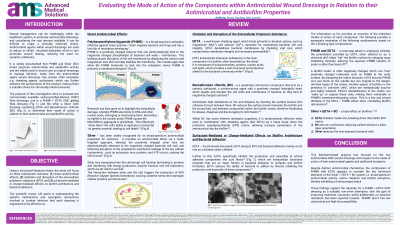
The purpose of this study is to evaluate the components within 2 subject devices in relation to their mode of action as an antimicrobial and antibiofilm product.
The combination of antimicrobials with additional excipients e.g. chelating agents, surfactants can enhance the performance of a woundcare product, and this investigation aims to understand the specific mechanisms and synergistic interactions involved to combat chronically infected wounds.
Methods:
Dressings evaluated were a PHMB + EDTA CMC gelling fibre dressing and a silver CMC dressing containing, EDTA and benzethonium chloride (BeCl). A literature review was performed focusing on three mechanistic domains: (1) direct antimicrobial effects, (2) chelation and disruption of the extracellular polymeric substance (EPS), and (3) surfactant-mediated or charge-mediated effects on biofilm architecture and bacterial adhesion.
Results:
It is widely known that the antimicrobial mechanisms of PHMB and Silver differ, which can lead to variation in certain properties, including antimicrobial resistance. However, both antimicrobials are recognised for their broad-spectrum activity. In the silver-based dressing, EDTA acts as a chelating agent to destabilise the biofilm matrix and BeCl functions as a cationic surfactant to disrupt bacterial membranes. In the PHMB + EDTA dressing, PHMB provides broad-spectrum antimicrobial activity while also acting as a surfactant, causing membrane disruption and interaction with bacterial DNA. EDTA contributes comparable chelating and biofilm-destabilising effects.
Discussion:
This literature-based analysis enabled comparative evaluation of two antimicrobial CMC wound dressings with respect to the mode of action of their antimicrobial agents and additional excipients. Despite distinct antimicrobial chemistries, the combination of PHMB with EDTA appears to recreate the key functional elements of the silver + EDTA + BeCl system—broad-spectrum antimicrobial activity, matrix chelation and biofilm disruption.