
.jpg)
Laboratory Research
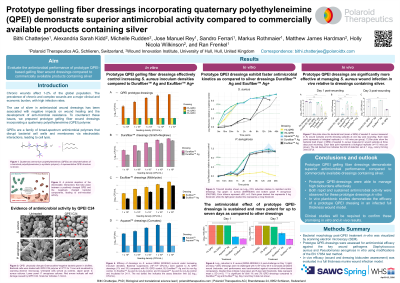
The use of silver in anti-microbial wound dressings has been associated with negative impacts on wound healing and the development of anti-microbial resistance. To counteract these issues, we aimed to determine the anti-microbial characteristics of prototype gelling fiber wound dressings incorporating quaternary polyethyleneimine (QPEI) polymers, designed with functional groups to enhance anti-microbial potency and prevent leaching into the wound bed. The characteristics of QPEI-incorporated prototype gelling fibers were evaluated relative to other commercially available gelling fibers containing silver.
Prototype QPEI-dressings were assessed for anti-microbial efficacy against the key wound pathogens Staphylococcus aureus and Pseudomonas aeruginosa in vitro using modifications of the EN 17854 test method. Characteristics evaluated included anti-microbial efficacy against high bioburden, durability of anti-microbial activity, as well as speed of action. In vivo efficacy (wound and dressing bioburden assessment) was also evaluated in a murine wound infection model.
In vitro, prototype QPEI-dressings effectively controlled increasing S. aureus inoculum densities (up to 1x10⁹ CFU) compared to silver-containing comparator dressings and QPEI-free controls. Moreover, the anti-microbial effect of prototype QPEI-dressings was sustained over repeated daily challenges for up to seven days. Importantly, prototype QPEI-dressings exhibited significantly faster anti-microbial kinetics as compared to silver-containing dressings. Finally, prototype QPEI dressings were significantly more effective at managing S. aureus wound infection in vivo relative to dressings containing silver.
These findings indicate that prototype QPEI-wound dressings may provide a superior approach to preventing or controlling bacterial infections within the wound. Crucially, QPEI polymers act through a unique physical mechanism that, unlike traditional silver dressings, may limit the development of antimicrobial resistance. The rapid and sustained anti-microbial activity and the ability of prototype QPEI-dressings to manage high bioburdens may lead to better outcomes for patients with chronic wounds. Clinical studies will be required to confirm these promising in vitro and in vivo results.