Introduction: Wound care clinicians must balance dressing securement with the risk of medical adhesive related skin injury (MARSI) when applying dressings. Shifting dressings can impede wound healing, leading most adhesives to be aggressive or require reinforcement with medical tape, both of which increase MARSI risk. A recent meta-analysis found a 16% MARSI prevalence and a treatment cost of $88.50 per injury (1), not including pain during adhesive removal. Recently, a light-switchable polyurethane adhesive was introduced for clinical use. Initial studies on human skin showed that the adhesive had strength comparable to other medical adhesives when unswitched but detached more gently than silicone adhesives in the switched state (2,3). Simulated use studies in healthy humans found an incisional negative pressure wound therapy system using this adhesive resulted in less skin irritation than alternatives, with similar dressing survivability (4). This case series details the use of light-switchable film dressings (LFD)* on dressings for patients with adhesive sensitivity or dermatitis.
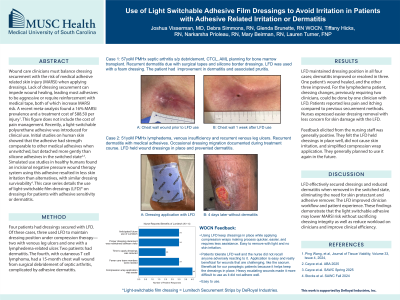
Methods: Four patients had dressings secured with LFD. Three cases used LFD to maintain dressing position under compression therapy—two with venous leg ulcers and one with a lymphedema-related ulcer. Two patients had dermatitis. The fourth, with cutaneous T cell lymphoma, had a 15-month chest wall wound from surgical debridement of septic arthritis, complicated by adhesive dermatitis.
Results: LFD maintained dressing position in all four cases; dermatitis improved or resolved in three. One patient’s wound healed, and the other three improved. For the lymphedema patient, dressing changes, previously requiring two clinicians, could be done by one clinician with LFD. Patients reported less pain and itching compared to previous securement methods. Nurses expressed easier dressing removal with less concern for skin damage with the LFD.
Discussion: LFD effectively secured dressings and reduced dermatitis when removed in the switched state, eliminating the need for skin protectant and adhesive remover. It improved clinician workflow and patient experience. These findings demonstrate that light switchable adhesive may lower MARSI risk without sacrificing dressing integrity as well as reduce workload on clinicians.

.jpg)