(CS-063) Early Experience with a Composite Ovine Forestomach Matrix Graft in Chronic Lower Extremity Wounds: A Multi-Center Retrospective Case Series
Friday, April 10, 2026
Anthony LaLama, DPM; Brandon Bosque, DPM, CWSP; Alpash Patel, DPM
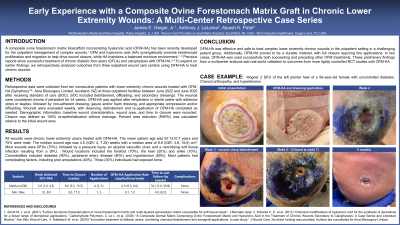
Introduction: Chronic wounds are a prevalent clinical challenge that negatively impacts patient quality of life, morbidity, mortality, and healthcare costs. Their management usually requires a multidisciplinary approach involving outpatient care and, at times, surgical intervention. One outpatient treatment option is a composite bioscaffold that contains ovine forestomach matrix and hyaluronic acid (OFM-HA). This multi-center retrospective case series presents initial findings from the use of OFM-HA to treat lower extremity chronic wounds in the outpatient setting.
Methods: A retrospective chart review of ten patients with lower extremity chronic wounds was conducted. Each patient had a single wound treated with OFM-HA after failing standard-of-care at three outpatient facilities. Before OFM-HA application, wounds were deemed free of infection and sharply debrided of non-viable tissue. OFM-HA was trimmed, rehydrated, and secured with either adhesive strips or staples. Wounds were dressed witha non-adherent primary contact dressing, gauze and/or foam dressing, and appropriately compressed and/or off-loaded. Demographics, baseline wound characteristics, and healing outcomes were reported.
Results: Most patients were elderly males with several comorbidities and complicating factors. Most wounds were diabetic foot ulcers (70%), with one pressure injury and one atypical vasculitic ulcer. Wounds achieved a 50% percent area reduction at a mean of 3.2±2.3 weeks, and a mean time to wound closure of 9.9±5.1 weeks. Patients received a median of 4 (IQR: 2, 5) OFM-HA applications, averaging 0.4±0.3 applications per week. The average time to the last follow-up was 36±26.8 weeks. No complications or recurrences were observed.
Discussion: Despite the complexity of this patient group, OFM-HA promoted timely and effective healing. In fact, patients took, on average, ~10 weeks to achieve full closure, with only ~1 application of OFM-HA every two weeks and no complications or recurrences. This indicates that OFM-HA can support efficient tissue regeneration, while underscoring OFM-HA’s safety and its durability in a hostile chronic wound environment. These positive clinical outcomes, along with a cost well below the newly implemented $127/cm2 cap on skin substitutes, translates into substantial cost-savings for the clinic. Altogether, this case series demonstrates that OFM-HA is a favorable alternative in the treatment of chronic lower extremity wounds.

.jpg)