
.jpg)
Clinical Research
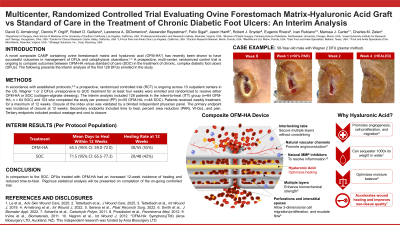
A prospective, multi-center, randomized control trial is on-going to compare outcomes between a novel composite CAMP containing ECM and hyaluronic acid (OFM-HA) versus standard of care (SOC) in the treatment of chronic DFUs. The following presents the interim analysis of the first 128 DFUs.
Methods:
In accordance with established protocols1-3, a prospective, randomized controlled trial (RCT) is ongoing across 8 outpatient centers in the US. Wagner 1 or 2 DFUs unresponsive to SOC treatment for at least four weeks were enrolled and randomized to receive either OFM-HA or SOC (collagen-alginate dressing). Patients received weekly treatment, for a maximum of 12 weeks. Closure of the index ulcer was validated by a blinded independent physicians panel. Primary endpoint was incidence of closure at 12 weeks. Secondary endpoints included time to heal, PAR, W-QoL, and pain. Tertiary endpoints included product wastage and cost to closure.
Results:
The interim analysis included 128 patients in the intent-to-treat (ITT) group (n=64 OFM-HA; n = 64 SOC) and 103 who completed the study per protocol (PP) (n=55 OFM-HA; n=48 SOC). The percentage of index ulcers healed at 12 weeks was 30/64 (47%) in the OFM-HA group and 20/66 (30%) in the SOC group. The time-to-heal was 67.3 days (95% Cl: 61.4-73.3) in the OFM-HA group and 74.0 days (95% Cl: 69.2-78.7) in SOC group. In the PP population the percentage of index ulcers healed at 12 weeks was 30/55 (55%) in the OFM-HA treatment group and 20/48 (42%) in the SOC group. The time-to-heal was 65.5 days (95% Cl: 59.0-72.0) in the OFM-HA treatment group and 71.5 days (95% Cl: 65.7-77.3) in SOC group.
Discussion:
In comparison to the SOC, DFUs treated with OFM-HA have an increased 12-week incidence of healing and reduced time-to-heal. Rigorous statistical analysis will be presented on completion of the on-going controlled trial.