
.jpg)
Laboratory Research
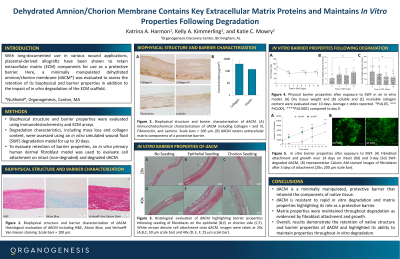
With long-documented use in various wound applications, placental-derived allografts have been shown to retain extracellular matrix (ECM) molecules and cytokines and growth factors. Here, a dehydrated amnion/chorion membrane (dACM*) was evaluated to assess biophysical properties and the impact of in vitro degradation on scaffold properties.
Methods:
Biophysical structure and composition were evaluated using immunohistochemistry, ECM assays, and a high-throughput multiplex proteomic array. Total protease, MMP-2, and MMP-9 inhibition were assessed using fluorometric assays. dACM was subjected to in vitro degradation for up to 10 days using a simulated wound fluid (SWF) model, and mass loss and collagen content were measured. Using an in vitro primary human dermal fibroblast model, scaffold properties were assessed through cell attachment, proliferation, and fibroblast gene expression in response to intact (non-degraded) and SWF-degraded dACM.
Results:
Proteomic evaluation identified 640 regulatory proteins retained within dACM. ECM proteins including collagens I and III and elastin, among others, were confirmed throughout the graft. dACM inhibited approximately 40% of total protease activity and significantly reduced MMP-2 and MMP-9 activity compared to controls. When exposed to SWF, there was a significant mass loss from days 0-3, but no substantial loss from days 3-10, corresponding with a significant increase in released soluble collagen throughout the study. Degraded dACM resulted in significantly more robust fibroblast attachment on 3-day, 7-day, and 10-day SWF degraded matrices; however, the length of degradation did not impact results. Fibroblast proliferation on 3-day degraded dACM resulted in significantly higher proliferation on days 1, 3, 7, and 10 compared to intact dACM. Retention of key properties was further confirmed by expression of fibroblast-related genes, including bFGF, HGF, IL-6, and VEGFA, which were significantly increased following exposure to both intact and SWF-degraded dACM conditioned media.
Discussion:
These results demonstrate retention of the complex structure and composition of dACM and highlighted its ability to maintain scaffold properties throughout in vitro degradation. Interestingly, for adhesion and proliferation, results were enhanced with degradation of dACM, likely due to the increased availability of binding sites revealed from degradation.