(LR-001) Native Collagen Scaffold + PHMB Acts as a Barrier to Bioburden and Supports Progression of Wounds through the Intrinsic Wound Healing Cascade in Two Distinct In Vivo Wound Models
Friday, April 10, 2026
Rami Nasrallah, BS – R&D Manager, Research & Development, Organogenesis; Kelly Kimmerling, PhD – Senior Manager, R&D, Research & Development, Organogenesis; Katie Mowry, PhD – VP, R&D, Research & Development, Organogenesis
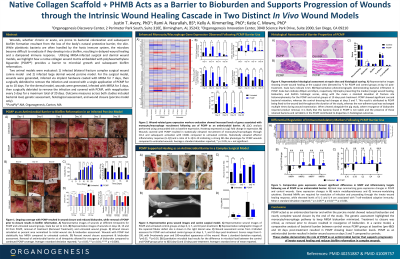
Introduction: Wounds, whether chronic or acute, are prone to bacterial colonization and subsequent biofilm formation resultant from the loss of the body’s natural protective barrier, the skin. While planktonic bacteria are often handled by the hosts immune system, the microbes become difficult to eradicate if they develop into a biofilm, resulting in delayed wound healing and a dampened immune response1. Utilizing MRSA-infected surgical and dermal wound models, we highlight how a native collagen wound matrix embedded with polyhexamethylene biguanide (PCMP*) provides a barrier to microbial growth and subsequent biofilm reformation.
Methods: Two animal models were evaluated: 1) infected bilateral fracture complex surgical wound canine model2 and 2) infected large dermal wound porcine model3. For the surgical model, wounds were generated, infected via implant hardware coated with MRSA for 7 days, then surgically debrided to remove the infection and covered with a single application of PCMP for up to 10 days. For the dermal model, wounds were generated, infected with MRSA for 3 days, then surgically debrided to remove the infection and covered with PCMP, with reapplication every 5 days for a maximum total of 20 days. Outcome measures across both studies included bacterial load, genetic assessment, histological assessment, and wound closure (porcine model only).
Results: Use of PCMP in the canine model resulted in a reduction in bacterial load and supported progression through the wound healing cascade as evidenced by cellular inflammation indicative of the proliferative phase of effective wound healing compared to control animals. Histological assessment of PCMP matrix found the presence of coccoid bacteria, indicating that the product was effective at killing bacteria within PCMP. The porcine model resulted in significantly diminished bioburden and improved wound closure in wounds with PCMP. If PCMP was removed, however, wounds were prone to resurgence of bioburden comparable to untreated wounds.
Discussion: These studies highlight PCMP antimicrobial barrier properties, resulting in reduced biofilm reformation and supporting progression of two distinct wound types through the intrinsic wound healing cascade.

.jpg)