
.jpg)
Laboratory Research
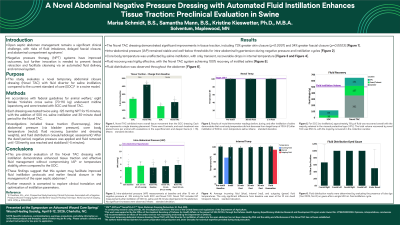
Open septic abdomen management remains a significant clinical challenge, with risks of fluid imbalance, delayed fascial closure, and abdominal compartment syndrome. Negative pressure therapy (NPT) systems have improved outcomes, but further innovation is needed to prevent fascial retraction and facilitate cleansing via an automated fluid delivery and removal system. This study evaluates a novel temporary abdominal closure dressing (Novel TAC) with fluid divertor for saline instillation, compared to the current standard of care (SOC)1 in a swine model.
Methods:
In accordance with federal guidelines for animal welfare2, eight female Yorkshire cross swine (70-110kg) underwent midline laparotomy and were treated with SOC and Novel TAC. Each dressing was tested twice using -125mmHg NPT, with the addition of 500mL saline instillation and 30-minute dwell period for the Novel TAC. Investigations included tissue traction (fluoroscopy), intra-abdominal pressure (via bladder pressure), core body temperature (rectal), fluid recovery (canister and dressing weights), and fluid distribution (visual/radiologic assessment)3.
Results:
The Novel TAC dressing demonstrated significant improvements in tissue traction, including 73% greater skin closure (p< 0.0001) and 34% greater fascial closure (p=0.0003). Intra-abdominal pressure (IAP) remained stable and well below thresholds for intra-abdominal hypertension during negative pressure and instillation cycles. Core body temperature was unaffected by saline instillation, with only transient, recoverable drops in internal temperature. Fluid recovery was highly effective, with the Novel TAC system achieving 100% recovery of instilled saline. Fluid distribution was observed throughout the abdomen.
Discussion:
This pre-clinical evaluation of the Novel TAC dressing with instillation demonstrates enhanced tissue traction and effective fluid management without compromising IAP or temperature stability when compared to the SOC. These findings suggest that this system may facilitate improved fluid instillation protocols and earlier fascial closure in the management of the open septic abdomen4. Further research is warranted to explore clinical translation and optimization of instillation parameters.