
.jpg)
Clinical Research
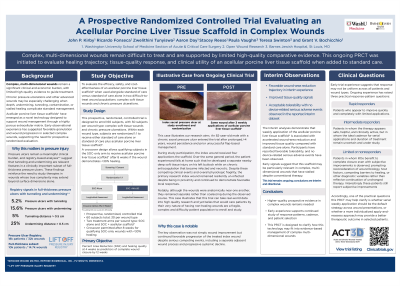
Complex, multi-dimensional wounds remain a significant clinical and economic burden, with limited high-quality evidence guiding treatments. Acellular porcine liver tissue scaffold* has emerged as a novel regenerative technique with early observational studies suggesting improved granulation tissue and accelerated closures via its highly porous extracellular matrix in complex wounds. To study more rigorously, we initiated a prospective randomized controlled trial (PRCT) to evaluate whether this CAMPs scaffold improves healing trajectories in complex soft tissue wounds compared with standard care alone.
Methods:
This IRB-approved PRCT enrolls adults with complex soft tissue wounds including chronic decubitus ulcerations, post fasciotomy wounds, and post necrotizing skin and soft tissue infections to evaluate wound-closure rates. Lower-extremity and pelvic wounds were selected by the treating clinical teams when healing poorly and consented for enrollment. Participants were randomized 1:1 into one of two groups:
At 4–6 weeks, patients in the Control Group were permitted to cross over to receive weekly scaffold placement for four weeks. Digital photographs were reviewed to assess healing progress, measure changes in wound volumes and area reduction trajectory rates, and qualitative evaluations of tissue and any sampling characteristics over time and across groups.
Results:
Interim analyses demonstrate that this acellular porcine liver tissue scaffold* is associated with accelerated wound-area reduction and improved tissue quality compared with standard care alone. Participants have reported favorable tolerability, and no device-related serious adverse events have been observed. Early signals suggest this scaffold* may be particularly beneficial in complex, multi-dimensional wounds that have stalled despite conventional therapy.
Discussion:
This PRCT represents one of the first randomized evaluations of an acellular porcine liver tissue scaffold* in advanced wound care. Early findings support its potential to improve healing trajectories and reduce overall wound burden. Ongoing study expansion and continued academic–industry collaboration will help define patient-selection criteria, optimize treatment protocols, and clarify the clinical and economic value of this technology.