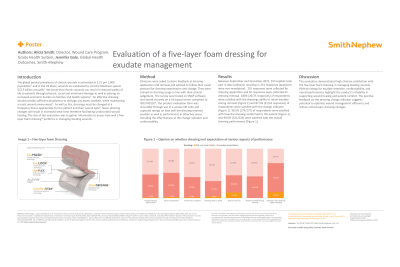
(EBP-015) Evaluation of a five-layer foam dressing for exudate management
Friday, April 10, 2026
Jennifer Gale, BA – Global Health Outcomes Analyst, Market Access & Health Outcomes, Smith + Nephew
Introduction: In the United States (US), 1 in 35 adults live with a chronic wound. These individuals require twice as many medical visits, medications, and products compared to unaffected adults and have a greater risk of mental health issues and social isolation. Foam dressings can aid in the healing process by absorbing and retaining exudate and bacteria. Selection of foam dressings should consider minimizing unnecessary dressing changes and preventing leaks as well as patient satisfaction levels. The aim of this evaluation was to gather information to assess how well a five-layer foam dressing* performs in managing exuding wounds.
Methods: Clinicians were asked to share feedback at dressing application and removal, and advised to follow their usual protocol for dressing examination and change. They were trained on dressing usage in line with their clinical judgement. The product evaluation form was accessible through use of a unique QR code and captured ratings on how well the dressing retained exudate as well as performance in other key areas, including the effectiveness of the change indicator and conformability.
Results: Between September and December 2025, 29 hospitals took part in data collection resulting in 231 responses (questions were non-mandatory). 100% (25/25 responses) of respondents were satisfied with the dressings ability to retain exudate during removal and 87.5% (21/24 responses) of respondents were satisfied with the change indicator. 98.5% (174/177) of respondents were satisfied with how the dressing conformed to the patient, and 98.6% (221/224) were satisfied with the overall dressing performance.
Discussion: The evaluation demonstrated high clinician satisfaction with the five-layer foam dressing in managing exuding wounds. Positive ratings for exudate retention, conformability, and overall performance highlight the product’s reliability in supporting wound healing and patient comfort. The positive feedback on the dressing change indicator suggests potential to optimize wound management efficiency and reduce unnecessary dressing changes.

.jpg)