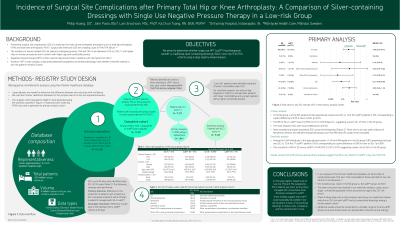
(CR-027 (RPT-002)) Incidence of Surgical Site Complications After Primary Total Hip or Knee Arthroplasty: A Comparison of Silver-containing Dressings with Single Use Negative Pressure Therapy in a Low-risk Cohort.
Saturday, April 11, 2026
5:15 PM - 5:40 PM ET
Cheryl Rothermel, RN – Molnlycke Health Care; John Pavia, MSc – Molnlycke Health Care; John Timmons, RN, DipNS, Master of Nursing, PG Dip PGTLHE – Molnlycke Health Care
Introduction: Surgical site complications (SSCs) are expensive and cause significant mortality and morbidity. Single-use closed-incision negative pressure wound therapy (ciNPWT) systems may reduce SSCs in high-risk patients, but their benefit for low-risk patients is underexplored.An investigation was undertaken to compare the rate of SSC between low-risk cohorts managed with silver-containing dressings incorporating silicone wound contact layers (SD) vs. ciNPWT following primary total hip arthroplasty (THA) or total knee arthroplasty (TKA).
Methods: A retrospective registry study was conducted using a large dataset (Premier Database, approximately 700,000 patients) who had undergone primary THA or TKA in the USA between 2022-2024. Low-risk patients were defined as scoring < 2 at the time of surgery on the Charleston Comorbidity Index. The primary endpoint was the difference in the proportion of subjects who developed at least one SSC within 90 days of surgery between those who had SD applied compared to those who had ciNPWT applied.
Results: A total of 10,351 patients in the SD group and 921 patients in the ciNPWT were identified as low-risk; the uneven distribution between groups was resolved using propensity score matching.In the matched cohort, 4/921 (0.4%) of the SD group and 12/921 (1.3%) of the ciNPWT group experienced at least one SSC within 90 days, resulting in a risk ratio (RR) of 0.33. The primary analysis demonstrated non-inferiority of SD relative to ciNPWT (p< 0.01). A sensitivity analysis confirmed the primary analysis.
Discussion: SD was non-inferior to ciNPWT in the prevention of SSCs after primary THA or TKA surgeries in low-risk patients. These findings support the use of SDs as a cost-effective and practical alternative to ciNPWT in low-risk THA/TKA outpatients.

.jpg)