
.jpg)
Laboratory Research
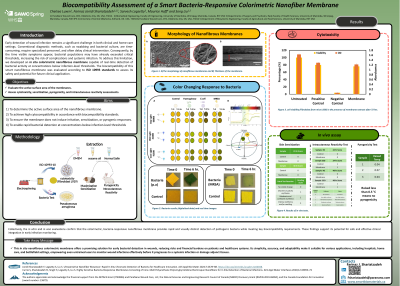
Effective early detection of wound infections remains a major challenge in both clinical and home-care settings. Conventional diagnostic approaches, including swabbing and culturing, are time-consuming, require trained personnel, and often delay intervention. By the time visible symptoms emerge, bacterial loads may have already surpassed critical thresholds, increasing the risk of systemic infection. To address this limitation, we developed an in situ colorimetric nanofiber membrane capable of real-time bacterial detection at concentrations below infection-level thresholds. The biocompatibility of this nanofibrous membrane was evaluated in accordance with ISO 10993 standards to ensure its suitability for future clinical application.
Methods:
The membrane was fabricated via electrospinning using a core solution of polyurethane and a shell solution composed of polyurethane, polyvinylpyrrolidone, hemicyanine dye, citric acid, and Tween 80. Brunauer–Emmett–Teller (BET) analysis was conducted to determine the active surface area. Biocompatibility testing (3rd party) followed ISO 10993 guidelines, including cytotoxicity, sensitization, pyrogenicity, and intracutaneous reactivity assessments.
Results:
The nanofibrous membranes exhibited a distinct color change within 6 hours upon exposure to Pseudomonas aeruginosa and MRSA at concentrations as low as 105 CFU/cm² which is well within clinically relevant ranges. The color transition was clearly distinguishable under both warm and cool light sources. Cytocompatibility testing demonstrated >75% cell viability. No dermal reactions were observed in the sensitization assay in guinea pigs. Intracutaneous reactivity testing in rabbits showed no erythema or edema, with a mean score difference < 0.1 compared to controls. Pyrogenicity testing confirmed no temperature increase >0.5 °C relative to controls.
Discussion:
Collectively, the in vitro and in vivo evaluations confirm that the colorimetric, bacteria-responsive nanofibrous membrane provides rapid and visually distinct detection of pathogenic bacteria while meeting key biocompatibility requirements. These findings support its potential for safe and effective clinical integration.