
.jpg)
Laboratory Research
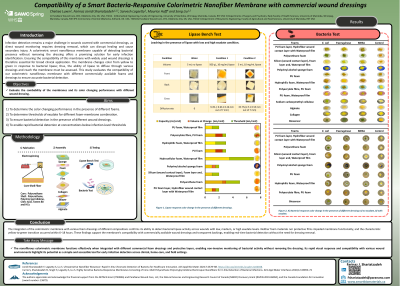
Infection detection remains a major challenge in wounds covered with commercial dressings, as direct wound monitoring requires dressing removal, which can disrupt healing and cause secondary injury. A colorimetric nanofibrous membrane capable of detecting bacterial presence without removing the dressing offers a promising solution for bacterial activity detection. Ensuring the compatibility of this membrane with widely used wound dressings is therefore essential for broad clinical application. The membrane changes color from yellow to green in response to bacterial lipase; thus, the ability of lipase to diffuse through various dressings and reach the membrane must be assessed. This study evaluates the compatibility of our colorimetric nanofibrous membrane with different commercially available foams and dressings to ensure accurate bacterial detection.
Methods:
The membrane was fabricated via electrospinning, using a polyurethane core and a shell formulation containing polyurethane, polyvinylpyrrolidone, a hemicyanine dye, citric acid, and Tween 80. The membrane was placed on a range of foams with and without hydrophobic barrier layers and lipase solution was introduced from below to examine color-change behavior. In a parallel assay, membranes positioned on top of various foams and covered with a transparent film were placed on agar plates inoculated with bacteria, and color responses were monitored over time.
Results:
Lipase diffusion tests showed that the colorimetric membrane is compatible with a broad range of leading foam dressings. Foams lacking hydrophobic barrier layers allowed lipase to reach the membrane, resulting in the expected color transition. In contrast, dressings containing hydrophobic layers blocked lipase transport and prevented color change. Compatibility was confirmed across foams composed of alginate, polyurethane, silicone, polyvinyl alcohol, hydrocellular materials, and polyacrylate. In vitro bacterial assays further demonstrated real-time bacterial detection even when the membrane was used in combination with foam and covered by a film. SEM imaging revealed that both bacterial cells and secreted lipase were able to migrate through the foams toward the membrane.
Discussion:
The integration of the colorimetric membrane with various foam dressings of different compositions confirms its ability to detect bacterial activity across wounds with low, medium, or high exudate levels. Neither foam materials nor protective films impeded membrane functionality, and the characteristic yellow-to-green transition occurred within 6–18 hours. These findings support the membrane’s compatibility with commercially available wound dressings and transparent backings, enabling real-time bacterial detection without the need for dressing removal.