
.jpg)
Clinical Research
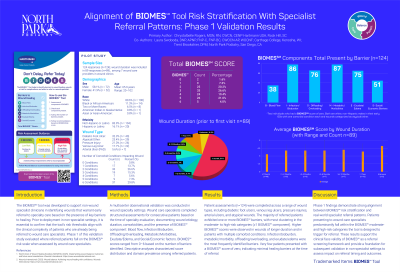
The BIOMES℠ tool was developed to support non-specialist clinicians in identifying wounds that warrant early referral to specialty care based on the presence of key barriers to healing. Prior to deployment in non-specialist settings, it is essential to confirm that the tool’s risk thresholds align with the clinical complexity of patients who are already being referred to wound care specialists. Phase 1 of this validation study evaluated where referred patients fall on the BIOMES℠ risk scale when assessed by wound care specialists.
Methods:
A multicenter observational validation was conducted in wound specialty settings. Wound care specialists completed structured assessments for consecutive patients based on the time of specialty evaluation, documenting wound etiology, duration, comorbidities, and the presence of BIOMES℠ domains: Blood flow, Infection/Bioburden, Offloading/Overloading, Metabolic/Morbidities, Exudate/Edema, and Social/Economic factors. BIOMES℠ scores ranged from 0–6 based on the number of barriers identified. Descriptive analyses characterized score distribution and domain prevalence among referred patients.
Results:
Patient assessments (currently 124 with higher number expected) were completed across a range of wound types, including diabetic foot ulcers, venous leg ulcers, pressure injuries, arterial ulcers, and atypical wounds. The majority of referred patients exhibited one or more BIOMES℠ barriers, with most clustering in the moderate- to high-risk categories (≥1 BIOMES℠ domain). Higher BIOMES℠ scores were observed in wounds of longer duration and in patients with multiple comorbid conditions. Infection/bioburden, metabolic/morbidity, offloading/overloading, and exudate/edema were the most frequently identified barriers. Very few patients presented with a BIOMES℠ score of zero, indicating minimal healing barriers at the time of referral.
Discussion:
Phase 1 findings demonstrate strong alignment between BIOMES℠ risk stratification and real-world specialist referral patterns. Patients presenting to wound care specialists predominantly fall within the BIOMES℠ moderate- and high-risk categories the tool is designed to trigger for referral. These results support the clinical face validity of BIOMES℠ as a referral screening framework and provide a foundation for subsequent validation in non-specialist settings to assess impact on referral timing and outcomes.