
.jpg)
Practice Innovations
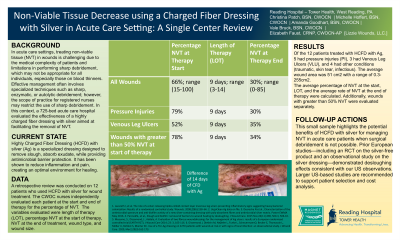
Managing non-viable tissue (NVT) in acute care wounds presents significant challenges due to patient complexity and limitations on debridement methods, particularly for those on anticoagulants. Traditional debridement techniques, such as sharp debridement, are often restricted by scope of practice, while enzymatic and autolytic debridement are slower, and ultrasound and maggot therapy are difficult to access. This retrospective review investigates the effectiveness of a negatively charged fiber (NCF) dressing with silver in facilitating NVT removal in an acute care setting where surgical debridement is contraindicated or not feasible.
In this study, twelve patients treated with NCF at a 725-bed acute care hospital were analyzed. Certified wound care nurses independently assessed the percentage of NVT at the start and end of therapy, along with wound type, size, and duration of treatment. The patient cohort included those with pressure injuries (n=5), venous leg ulcers (n=3), and other acute wounds (n=4), such as traumatic, skin tear, and infectious wounds. The average wound size was 51 cm², ranging from 0.3 to 255 cm².
The results demonstrated a consistent reduction in NVT across all wound types. Notably, wounds with initial NVT greater than 50% showed significant improvement, with an average reduction from 78% to 34% NVT after nine days of NCF application. Despite the limited sample size, these findings suggest that NCF is a safe and effective alternative for NVT management in acute care settings where sharp debridement is not feasible. The dressing's antimicrobial barrier properties and its ability to facilitate wound bed preparation may reduce wound burden and optimize healing.
The study highlights the potential of NCF dressings in acute care, suggesting that further prospective studies with larger cohorts are necessary to optimize patient selection, evaluate cost-effectiveness, and compare outcomes with established debridement methods. These findings have important implications for practice, offering a viable option for managing complex wounds in settings with debridement limitations.