(EBP-013) ACTIVATE: A Practical, Evidence-Based Wound Care Pathway for Clinician Decision-Making
Friday, April 10, 2026
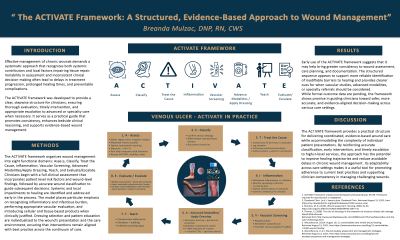
Introduction: Effective management of chronic wounds demands a systematic approach that recognizes both the underlying systemic contributors and the local factors impairing tissue repair. Variability in assessment and inconsistent clinical decision-making often lead to delays in treatment progression, prolonged healing times, and preventable complications. The ACTIVAATE framework was developed to provide a clear, stepwise structure for clinicians, ensuring thorough evaluation, timely intervention, and appropriate escalation to advanced or specialty care when necessary. It serves as a practical guide that promotes consistency, improves clinical reasoning at the bedside, and supports evidence-driven wound management.
Methods: The ACTIVATE framework organizes wound management into eight functional domains: Assess, Classify, Treat the Cause, Inflammation, Vascular Screening, Advanced Modalities/Apply Dressing, Teach, and Evaluate/Escalate. Clinicians begin with a full clinical assessment that incorporates patient-level risk factors and wound-level findings, followed by accurate wound classification to guide subsequent decisions. Systemic and local impediments to healing are identified and addressed early in the process. The model places particular emphasis on recognizing inflammatory and infectious burden, performing appropriate vascular evaluation, and introducing cellular and tissue-based products when clinically justified. Dressing selection and patient education are individualized to the wound’s presentation and the care environment, ensuring that interventions remain aligned with best practice across the continuum of care.
Results: Early use of the ACTIVATE framework suggests that it may help bring greater consistency to wound assessment, care planning, and documentation. The structured sequence appears to support more reliable identification of modifiable barriers to healing and provides clearer cues for when vascular studies, advanced modalities, or specialty referrals should be considered. While formal outcome data are pending, the framework shows promise in guiding clinicians toward safer, more accurate, and evidence-aligned decision-making across various care settings.
Discussion: The ACTIVATE framework provides a practical structure for delivering coordinated, evidence-based wound care while accommodating the complexity of individual patient presentations. By reinforcing accurate classification, early intervention, and timely escalation to higher-level services, the approach has the potential to improve healing trajectories and reduce avoidable delays in chronic wound management. Its adaptability across care settings makes it a useful tool for promoting adherence to current best practices and supporting clinician competency in managing challenging wounds.

.jpg)