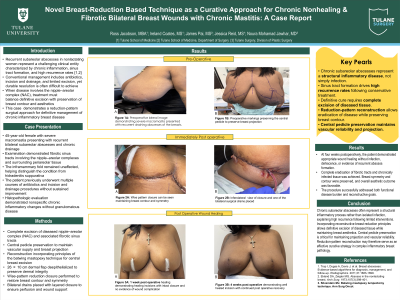
(CS-073) Novel Breast-Reduction Based Technique as a Curative Approach for Chronic Nonhealing & Fibrotic Bilateral Breast Wounds with Chronic Mastitis: A Case Report
Friday, April 10, 2026
Jessica Reid, MS; James Pai, MS
Introduction:
Recurrent subareolar abscesses in nonlactating women remain notoriously difficult to treat. Repeated drainage, antibiotics, and limited excisions often fail due to chronic inflammation, sinus tract formation, and biofilm-associated recurrence. When disease involves the nipple–areolar complex (NAC), traditional approaches risk distortion, delayed healing, and poor aesthetic outcomes. We present a case in which reduction-pattern, central-pedicle–preserving amputation technique definitively eradicated bilateral refractory disease while maintaining breast shape and symmetry.
Methods:
A 45-year-old female with severe macromastia presented with recurrent draining abscesses and fibrotic tracts involving the bilateral nipple-areolar complexes and periareolar breast tissue. Critically, the disease was confined to the nipple–areolar and locally adjacent regions, sparing the inframammary fold, which helped distinguish this disorder from hidradenitis suppurativa. Histopathology confirmed nonspecific chronic inflammation without granulomatous features. Definitive surgical management was then undertaken: complete excision of all diseased tissue, preservation of a central pedicle to maintain breast projection, and closure using a 26 x 10 cm dermal flap that was deepithelialized, which is the removal of the epidermal layer while preserving the underlying dermis, in a Wise pattern to restore contour and symmetry. Following bilateral drain placement, complete closure was achieved with excellent perfusion and aesthetic results.
Results:
At the four-week postoperative appointment, the patient showed adequate signs of healing, with no major wound complications or infections. She was continued with conservative wound management. The primary goal of eliminating all fibrotic tracts and infected tissue was successfully achieved, while simultaneously preserving breast symmetry and contour. This case highlights the definitive curative potential and utility of adapting established plastic surgical methods to manage complex, refractory inflammatory breast disease.
Discussion: This case report illustrates the effective adaptation of a Wise-pattern breast reduction–based amputation technique as a potentially curative strategy for chronic subareolar abscesses. This novel approach directly addressed the underlying issues of tunneling, scarring, and biofilm-associated recurrence common in refractory inflammatory breast disease. By combining complete excision with aesthetic reconstruction, this method represents a viable and definitive reconstructive strategy for managing persistent and complex breast pathologies.

.jpg)