(CS-021) Decreasing Bacterial Burden in Infected Wounds Using a 3D Biomimetic Matrix
Friday, April 10, 2026
Garismar Ramirez, BS; John Lantis, MD
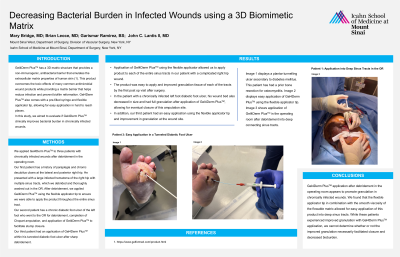
Introduction: Chronic infected wounds present a significant challenge due to persistent bacterial colonization that impedes granulation and closure. Traditional debridement and antimicrobial strategies often fail to achieve adequate bacterial control in deep, irregular, or anatomically complex wounds such as sinus tracts or amputation stumps. Advanced biomaterials that can physically protect the wound bed and support tissue regeneration may offer substantial advantages in managing bioburden. A Biomimetic Matrix* is a non-immunogenic, flowable, 3D scaffold engineered to emulate human extracellular matrix and provide a protective antibacterial barrier. Its viscosity and flexible applicator tip allow precise delivery into tunnels and cavities, potentially supporting granulation while limiting bacterial proliferation. This study evaluates early clinical outcomes following biomimetic matrix application in three chronically infected wounds treated in the operating room (OR) after surgical debridement.
Methods: A Biomimetic Matrix* was applied intraoperatively after surgical debridement. The first patient, with paraplegia and longstanding decubitus ulceration, had a large infected right-hip hematoma containing multiple sinus tracts. The biomimetic matrix was delivered throughout each tract using the flexible applicator tip. The second patient who had completion of a Chopart amputation for a chronic diabetic foot ulcer underwent application to support stump granulation and closure. The third patient received the product after removal of infected hardware from the right foot. Postoperative wound assessments included granulation quality and relative wound-size changes.
Results: In the complex right-hip wound, the biomimetic matrix reached the full extent of each sinus tract and resulted in visible granulation by the first postoperative visit. The diabetic foot ulcer demonstrated decreased wound size and eventual full granulation. The third patient similarly showed improved granulation after hardware removal and product application. The product was easy to apply and conformed well to deep and irregular wound spaces.
Discussion: A Biomimetic Matrix* applied after OR debridement appears to support granulation in chronically infected wounds, particularly those with complex sinus tracts. We found that the flexible applicator tip in combination with the smooth viscosity of the flowable matrix allowed for easy application of this product into deep sinus tracts.Larger controlled studies are needed to determine whether biomimetic matrix facilitated wound closure.

.jpg)