(CS-022) Efficacy of Antimicrobial Wound Spray on Healing Chronic Lower Extremity Wounds
Friday, April 10, 2026
Garismar Ramirez, BS; John Lantis, MD
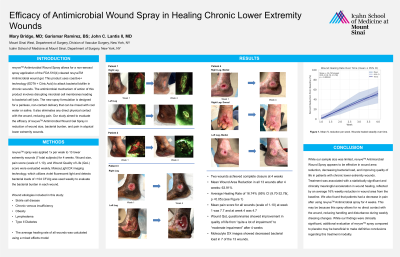
Introduction: Antimicrobial Wound Spray*, a novel non-contact formulation of the Antimicrobial Wound Gel CoActive+ technology**, was designed to provide potent antimicrobial activity while minimizing wound disruption. This study assesses its clinical effectiveness in accelerating wound closure, reducing bacterial burden, and improving patient-reported outcomes in individuals with chronic, atypical, and difficult-to-treat lower-extremity wounds.
Methods: Antimicrobial Wound Spray* was applied once per week for 4 weeks. Wound size, pain score (scale of 1-10), Wound Quality of Life (QoL) score were evaluated weekly. In addition, Moleculyte Dx imaging technology which utilizes violet fluorescent light and detects bacterial loads of >104 CFU/g was used weekly to evaluate the bacterial burden in each wound.
Results: Thirteen lower extremity wounds (7 total subjects) were included. Mean wound area reduction in the 13 included wounds after 4 applications of Antimicrobial Wound Spray* was 63.91%. Mean wound area decreased steadily over time with an average healing rate of 16.74% per week (95% CI 9.70-23.78, p< 0.05).Two wounds achieved complete closure at 4 weeks. Average pain score for all wounds (scale of 1-10) at week 1 was 7.7 and at week 4 was 4.7. Wound QoL questionnaires scored using the Likert Scale had a mean score of 2.3 at week 1, indicating quite a lot of impairment to quality of life, and a mean score of 1.67 at week 4, indicating a moderate impairment to quality of life. Moleculyte DX images showed decreased bacterial load in 7 of the 13 wounds.
Discussion: While our sample size was limited, Antimicrobial Wound Spray* appears to be effective in wound area reduction, decreasing bacterial load, and improving quality of life in patients with chronic lower extremity wounds. We found that patients who normally experience a significant amount of pain had a decrease in overall pain score after using antimicrobial wound spray* for 4 weeks. This may be because this spray allows for no direct contact with the wound, reducing handling and disturbance during weekly dressing changes. While our findings were clinically significant, additional evaluation of Antimicrobial Wound Spray* compared to placebo may be beneficial to make definitive conclusions regarding this treatment modality.

.jpg)