
.jpg)
Clinical Research
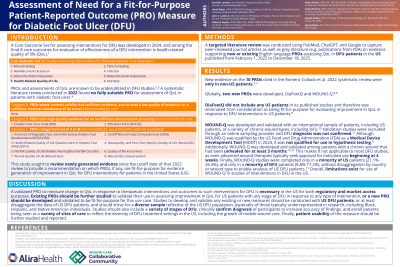
A Core Outcome Set for assessing interventions for Diabetic Foot Ulcer (DFU) was developed in 2024, and among the final 8 core outcomes for evaluation of effectiveness of a DFU intervention is health-related quality of life. Patient-reported outcome measures and assessments of quality life are known to be underutilized in DFU studies. A systematic literature review conducted in 2022 found no fully suitable PRO for assessment of quality of life in patients with diabetic foot ulcer. This study sought to review newly generated evidence since the cutoff date of that 2022 review to provide a recommendation on which PROs, if any, are fit-for-purpose for evidence generation of improvement in quality of life for DFU interventions for patients in the United States.
Methods: A targeted literature review was conducted using PubMed, ChatGPT, and Google, and Gemini to capture peer-reviewed journal articles as well as grey literature (e.g. publications from FDA) on evidence supporting new or existing English language PROs assessing quality of life in DFU patients in the United States published from February 1, 2022 to December 18, 2025.
Results: New evidence on the PROs cited in the 2022 review were only in non-US patients. Globally, two new PROs were developed, DiaFootQ and WOUND-Q. DiaFootQ did not include any US patients and therefore was eliminated from consideration. WOUND-Q was developed and validated with an international sample of patients, including US patients, of a variety of chronic wound types, including DFU. Although WOUND-Q was qualified by FDA as a Medical Device Development Tool (MDDT) in 2024, it was not qualified for use in hypothesis testing. Additionally, WOUND-Q was developed and validated among patients with a chronic wound that had been unhealed for at least 3 months. This makes it not applicable to most DFU studies, as even advanced wound therapies typically seek approval for indicated use beginning at 4 weeks.
Discussion: While the WOUND-Q PRO was qualified for use by the FDA as a Medical Device Development Tool (MDDT), limitations exist for use in studies of interventions in DFU. Existing PROs should be further studied to validate their use in assessing improvement in quality of life for US patients with any stage of DFU in response to any type of intervention, or a new PRO should be developed and validated to be fit-for-purpose for this use case.