(CS-054) Necrotizing Fasciitis of the Lower Extremity: Risk Factors, Surgical Strategies and Adjunctive Treatments Associated with Improved Survival – A Case Series of 22 Consecutive Patients in 2025.
Friday, April 10, 2026
Autumn Forrest, CMA – Research Coordinator, OrthoCare, Cone Health Medical Group
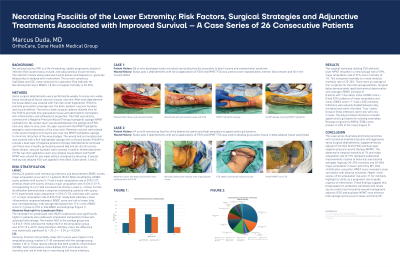
Introduction: Necrotizing fasciitis (NF) is a life threatening, rapidly progressive, bacterial infection that causes fascia, muscle and subcutaneous tissue necrosis. The infection travels along avascular fascial planes and diagnosis is generally delayed due to delayed skin involvement. Current consensus (2023-2025 literature), Laboratory Risk Indicator for Necrotizing Fasciitis (LRINEC) ≥ 8 demonstrates a mortality of 45-50%.
Methods: Serial surgical debridement were performed to excise non viable tissue including all fascia, necrotic muscle, and skin. After each debridement the tissue defect was covered with Fish Skin Graft fragments (FSGf) to promote granulation coverage of tissue defects. The FSGf was directly covered with Negative Pressure Wound Therapy hydrophilic sponge (NPWT hydrophilic) and covered with a thin hydrophobic sponge with a silicone border.
Results: The surgical technique resulted in a limb salvage rate of 59%, major amputation rate of 31% and a mortality of 1 %. A survival rate of 99%. Surgical delay demonstrated rapid biochemical deterioration with average LRINEC increase of 8 points with 7 day delay. Initial LRINEC score > 8 had 50% incidence of major amputation and initial LRINEC score >11 had a 30% mortality.
Discussion: This case series demonstrates the importance of surgical debridement within 24 hours of presentation, including the benefits of adjunctive modalities of FSGf and NPWT hydrophilic.

.jpg)