
.jpg)
Laboratory Research
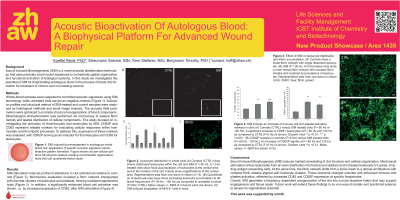
Chronic and non-healing wounds remain a major clinical challenge, characterized by impaired hemostasis, deficient extracellular matrix organization, and inadequate immune and cellular activation. Current autologous and biomaterial-based therapies are limited by inconsistent biological activity, lack of spatial organization within clots, and the need for exogenous additives that increase cost and complexity. There is a critical unmet need for a rapid, sterile, and reproducible point-of-care approach capable of transforming autologous blood into a biologically active, structured wound matrix to improve tissue repair outcomes.
Methods:
Whole-blood samples were exposed ex vivo to reproducible, frequency-controlled acoustic fields using Sound Induced Morphogenesis (SIM) technology. Untreated blood clots served as negative controls. Acoustic parameters were optimized to promote structural reorganization of fibrin and cellular components. Clot microarchitecture was assessed by microscopy, focusing on fibrin density and spatial distribution of leukocytes and platelets. Cellular activation was evaluated by microscopy through the detection of CD83 (a marker of leukocyte activation) and CD62P (a marker of platelet activation). Structural and activation metrics were compared between SIM-treated and control samples.
Results:
SIM treatment induced marked architectural and functional changes in autologous blood clots compared with untreated controls. Microscopic analysis demonstrated a dense, highly organized fibrin network containing spatially defined cellular clusters of leukocytes and platelets, forming localized regenerative microdomains. SIM-treated samples showed significantly increased cellular activation, including elevated CD83 expression indicating enhanced leukocyte activation. These data demonstrate reliable conversion of passive clots into bioactive, spatially organized matrices.
Discussion:
These findings show that acoustically driven bioactivation can overcome key biological limitations of conventional autologous clot-based wound therapies. By enabling rapid, additive-free, and reproducible formation of structured, bioactive clots at the point of care, SIM represents a novel platform to address complex non-healing wounds. This technology has the potential to improve angiogenesis, immune coordination, and tissue regeneration. Ongoing work will extend evaluation into ex vivo wound models and preclinical systems to confirm therapeutic performance and clinical translation potential.