
.jpg)
Practice Innovations
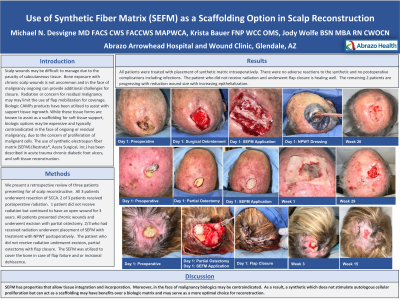
Scalp wounds may be difficult to manage due to the paucity of subcutaneous tissue. Bone exposure with chronic scalp wounds is not uncommon and in the face of malignancy ongoing can provide additional challenges for closure. Radiation or concern for residual malignancy may may limit the use of flap mobilization for coverage. Biologic CAMPs products have been utilized to assist with support tissue ingrowth. While these tissue forms are known to assist as a scaffolding for soft tissue support, biologic options may be expensive and typically contraindicated in the face of ongoing or residual malignancy, due to the concern of proliferation of malignant cells.
The use of synthetic electrospun fiber matrix (SEFM) (Restrata ®, Acera Surgical, Inc.) has been described in acute trauma chronic diabetic foot ulcers, soft tissue reconstruction.
Methods:
We present a retrospective review of three patients presenting for of scalp reconstructive. All 3 patients underwent resection of SCCA. 2 of 3 patients received postoperative radiation. 1 patient did not receive radiation but continued to have an open wound for 3 years. All patients presented chronic wounds and underwent excision with partial ostectomy. 2/3 who had received radiation underwent placement of SEFM with treatment with NPWT postoperatively. The patient who did not receive radiation underwent excision, partial ostectomy with flap closure. The SEFM was utilized to cover the bone in case of flap failure and or incisional dehiscence.
Results:
All patients were treated with placement of synthetic matric intraoperatively.
There were no adverse reactions to the synthetic and no postoperative complications including infections. The patient who did not receive radiation and underwent flap closure is healing well. The remaining 2 patients are progressing with reduction wound size with increasing epithelialization.
Discussion:
SEFM has properties that allow tissue integration and incorporation. Moreover, in the face of malignancy biologics may be contraindicated. As a result, a synthetic which does not stimulate autologous cellular proliferation but can act as a scaffolding may have benefits over a biologic matrix and may serve as a more optimal choice for reconstruction.