
.jpg)
Case Series/Study
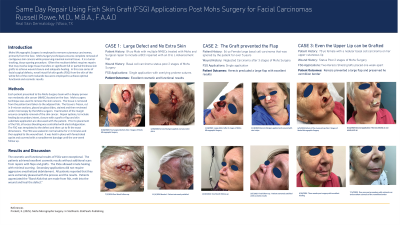
Introduction: Mohs Micrographic Surgery is employed to remove cutaneous carcinomas, primarily from the face. Mohs Surgery techniques ensures complete removal of contiguous skin cancers while preserving maximal normal tissue. It is a tumor tracking, tissue sparing procedure. Often the resultant defect requires repairs that may involve large tissue transfers or significant full or partial thickness skin grafts to achieve wound closure and adequate healing. In this case series of facial surgical defects, novel skin substitute “grafts” from the skin of the white fish of the north Icelandic Sea were employed to achieve optimal functional and cosmetic results.
Methods:
Methods: Each patient presented to the Mohs Surgery team with a biopsy proven non melanotic skin cancer (NMSC) located on the face. Mohs surgery technique was used to remove the skin cancers. The tissue is removed from the patient and taken to the adjacent lab. The tissue is frozen, cut in 6-micron sections, placed on glass slides, stained and then reviewed under microscopy by the Mohs surgeon. Examination of the margin ensures complete removal of the skin cancer. Repair options, to include healing by secondary intent, closure with a graft or flap and skin substitute application are discussed with the patient. Prior to placement of the skin substitute, all excess bleeding was controlled with electrofulguration. The graft was templated to the defect and then cut to fit the exact dimensions. The graft was soaked in normal saline for 2-3 minutes and then applied to the wound bed. It was held in place with fenestrated opsite and covered with a nonadherent bandage until the one-week follow up.
Results: The cosmetic and functional results of fish skin grafts were exceptional. The patients achieved excellent cosmetic results without additional scars from repairs with flaps and grafts. The fish skin grafts allowed innate healing with minimal scarring. Secondary applications did not require aggressive anesthetized debridement.
Discussion:
All patients reported that they were extremely pleased with the process and the results. Patients appreciated the “Band-Aids that are made from fish, melt into the wound and heal the defect.”