(CR-024) Clinical Evaluation of an Autologous Blood Patch System for Chronic Diabetic Foot Ulcers: A Multicenter Prospective Study
Friday, April 10, 2026
Introduction: Chronic diabetic foot ulcers (DFUs) remain one of the most challenging and costly complications in wound care, often resistant to standard therapies and associated with infection, amputation, and impaired quality of life. Biologic treatments that leverage the patient’s own healing mechanisms have emerged as promising alternatives. This study evaluated the clinical performance of an autologous blood patch system, a point-of-care therapy that transforms a small sample of whole blood into a stabilized clot patch creating a biologically active wound matrix rich in regenerative components in comparison with standard of care (SOC) in patients with chronic DFUs.
Methods: In this prospective, multicenter, open-label controlled study, 20 adults with chronic DFUs (≥4 weeks’ duration) were enrolled across three sites. Patients received either the autologous blood patch system plus SOC (n = 10) or SOC alone (n = 10) for up to 12 weeks. Weekly assessments documented wound size, closure, and safety. The primary endpoint was the incidence of complete wound closure at 12 weeks; secondary endpoints included time to closure, percent area reduction (PAR) at 4, 8, and 12 weeks, and adverse events. The autologous blood patch system (FastSkin®) was applied at the point of care following standard preparation procedures.
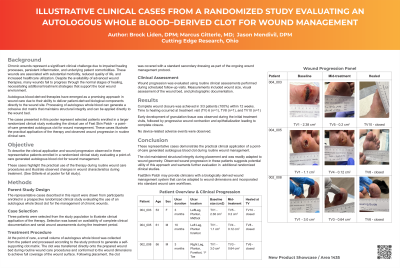
Results: Treatment with the autologous blood patch system achieved a 6-fold higher closure rate than SOC (60% vs 10%) and a faster median time to closure (9 weeks vs 11 weeks). Mean PAR reached 93% at 8 weeks in the treatment group versus 33% for SOC, with durable closure confirmed at follow-up. Treated wounds demonstrated rapid granulation, epithelialization, and improved tissue quality. No treatment-related adverse events were reported.
Discussion: This clinical study demonstrates that the autologous blood patch system is a safe and effective biologically active therapy for chronic DFUs. By utilizing the patient’s own blood to create a regenerative matrix, it re-engages natural healing pathways and accelerates closure. These findings establish a clinical foundation for future regenerative enhancements using advanced bioactivation strategies in wound repair.

.jpg)