
.jpg)
Case Series/Study
Accelerated wound healing has been reported with adjunctive use of negative pressure wound therapy (NPWT) and a reticulated open-cell foam (ROCF) dressing interface across various wound types.1,2 However, wound care and dressing changes with ROCF-interface dressings can be painful.3,4 An all-in-one dressing5 composed of encapsulated ROCF, a perforated nonadherent layer, and hybrid acrylic-silicone drape is available with an extended wear time, expanded wound type utilization, and potential to reduce pain during therapy and dressing changes.
Methods:
Wounds were appropriately debrided, and antibiotics prescribed as needed. Patients initially received adjunctive treatment with NPWT using traditional ROCF-interface dressings or NPWT with instillation and dwelling of a topical wound solution (NPWTi-d). Once the wounds reached appropriate size, therapy was switched to NPWT with all-in-one dressing. An all-in-one wound dressing with drape was applied over the wound, extending at least 5 cm beyond the wound edge, and connected via tubing to an NPWT unit. Negative pressure was applied at -125 mmHg. All-in-one dressings were changed at least once per 7 days.
Results:
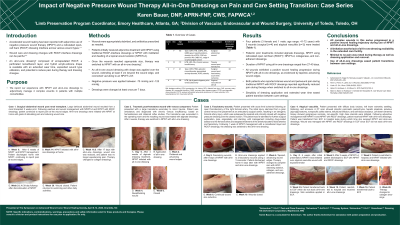
Four patients (3 female and 1 male; age range: 41-72) with 5 wounds (surgical (n=4) and atypical vasculitis (n=1)) were treated. Patients’ prior treatments included alginate dressings, NPWT using reticulated open cell foam (ROCF), NPWTi-d, collagenase, and non-adherent dressings. Duration of NPWT using all-in-one dressings ranged from 27-40 days. All wounds exhibited a positive wound healing progression during therapy, as evidenced by tapered, advancing wound edges. Both patients who reported intense wound and periwound pain during traditional NPWT with ROCF dressings reported significantly reduced pain during therapy when switched to all-in-one dressings. Simplicity of dressing application and extended wear time eased patient transition between care settings.
Discussion:
All complex wounds in this series progressed in a positive wound healing trajectory during use of NPWT and all-in-one dressings. A limitation was the lack of all-in-one dressing availability in the extended care facility. Minimal to no pain was noted during therapy as well as dressing application and removal. Use of all-in-one dressings, versus ROCF-interface dressings, eased patient transitions between care settings.