
.jpg)
Case Series/Study
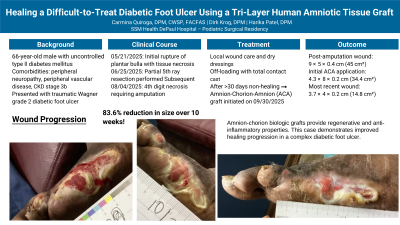
Patient is a 66 year old male with a primary medical history of uncontrolled type II diabetes mellitus with peripheral neuropathy, extensive peripheral vascular disease, stage 3b chronic kidney disease, hypertension, class 1 obesity, and hyperlipidemia. This patient has a complex vascular surgery history with procedures performed on the bilateral lower extremities.
Patient presented to the office with a traumatic Wagner-Meggitt grade 2 diabetic foot ulceration (DFU) secondary to a ruptured bulla with underlying tissue necrosis in May of 2025. This tissue necrosis continued advancing with associated soft tissue and bone infection. This required surgical cure via a left partial 5th ray resection during late June of 2025. By early August the left 4th digit was necrotic and required complete amputation.
Utilization of a biologic Amnion-Chorion-Amnion (ACA) skin substitute was initiated in late September upon approval.
Methods:
Initial treatment consisted of observation, dry dressings, and offloading via a total contact cast (TTC). Use of an ACA skin substitute was initiated after ulcer failed to respond to standard ulcer care treatment of greater than 30 days.
Wound defect edges were beveled with #15 scalpel. The ACA graft was then trimmed ulcer dimensions and placed according to the manufacturers recommendations. The graft was secured with adaptic, steri-strips, dry pressure dressing and off-loading (TTC).
Results:
Measurements post 4th digital amputation with graft application (08/19/25):
9 x 5 x 0.4 cm
Area: 45 cm^2
Volume: 18 cm^3
Pre-graft wound measurement at initial application of triple-layer skin substitute (09/30/25):
4.3 x 8 x 0.2 cm
Area: 34.40 cm^2
Volume: 6.88 cm^3
Pre-graft application wound measurement at recent appointment (12/09/25):
3.7 x 4.0 x 0.2 cm
Area: 14.80 cm^2
Volume: 2.96 cm^3
Discussion:
The development of biologics (ACA) demonstrates a new approach to wound care, with treating chronic non-healing wounds with unique tissue regenerative, anti-inflammatory, and antibacterial properties (Palanker, 2019). This case study shows the utilization of ACA was instrumental in overcoming barriers to resolving DFU’s.