
.jpg)
Health Economics
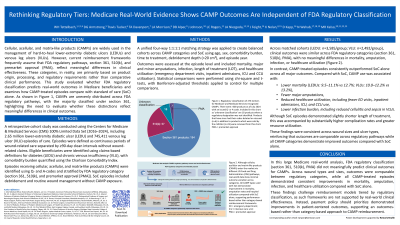
CAMPs are widely used for lower-extremity diabetic ulcers (LEDUs) and venous leg ulcers (VLUs), yet reimbursement frameworks often assume that the FDA regulatory category 361, 510(k), or premarket approval (PMA), reflects differences in clinical performance. Evidence validating these assumptions is limited. This study evaluated whether regulatory classification predicts real-world effectiveness and how episodes treated with these technologies compare with standard of care (SOC) alone.
Using a CMS limited data set (2016–2024), we analysed 2.65 million LEDU and 745,411 VLU episodes. CAMP-treated episodes were assigned to regulatory categories and matched with SOC using four-way matching on age, sex, comorbidities, time to treatment, debridement depth, and episode year. Episodes receiving CAMPs were stratified by regulatory categories, and 4-way 1:1 matching was used to balance cohorts across age, comorbidities, episode year, time to treatment, and debridement depth. Bonferroni correction addressed multiple comparisons.
Regulatory classification did not meaningfully predict clinical outcomes. Across matched LEDU (n=3,585/group) and VLU (n=2,492/group) cohorts, differences among PMA, 510(k), and 361 products were mainly non-significant. In contrast, allCAMP groups significantly outperformed SOC. CAMP-treated episodes showed lower mortality (LEDUs: 9.5–11.1% vs 12.7% SOC; VLUs: 10.0–12.2% vs 13.2% SOC), fewer amputations, and substantially reduced ED, ICU, and CCU utilization. Benefits were consistent across wound sizes. SOC episodes showed slightly shorter length-of-treatment (LOT) but substantially higher complication rates.
The FDA regulatory pathway does not predict real-world CAMP effectiveness in Medicare beneficiaries with hard-to-heal ulcers. CAMPs, regardless of category, consistently reduce mortality, amputations, infections, and hospital utilization compared with SOC alone. These findings challenge reimbursement models tiered by regulatory category, as outcomes across these technologies appear statistically similar.