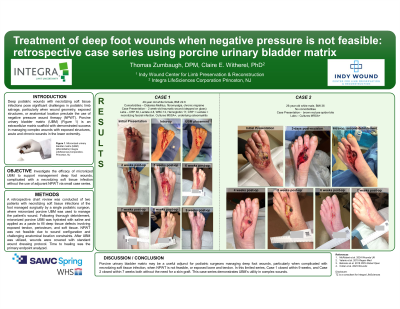
(CS-181) Treatment of deep foot wounds when negative pressure is not feasible: a retrospective case series using porcine urinary bladder matrix
Friday, April 10, 2026
Claire Witherel, PhD
Introduction: Deep podiatric wounds with necrotizing soft tissue infections pose significant challenges in podiatric limb salvage, particularly when wound geometry, exposed structures, or anatomical location preclude the use of negative pressure wound therapy (NPWT). Porcine urinary bladder matrix (UBM) is an extracellular matrix scaffold with demonstrated success in managing complex wounds with exposed structures, acute and chronic wounds in the lower extremity.
Methods: A retrospective review was conducted of two patients with necrotizing soft tissue infections of the foot managed surgically by a single podiatric surgeon. Following thorough debridement, micronized porcine UBM was hydrated with saline and applied as a paste to fill deep tissue defects involving exposed tendon, periosteum, and soft tissue. NPWT was not feasible due to wound configuration and challenging anatomical location constraints. After UBM was utilized, wounds were covered with standard wound dressing protocol. Time to healing was the primary endpoint analyzed.
Results: Case 1: a well-controlled diabetic female with a retained foreign body complicated by necrotizing fasciitis tracking along tendon planes. Case 2: a younger male who developed necrotizing fasciitis following a brown recluse spider bite affecting the dorsal second toe. Both patients achieved complete wound healing within six weeks without the use of NPWT, flap coverage, or additional reconstructive procedures.
Discussion: Porcine urinary bladder matrix may be a useful adjunct for podiatric surgeons managing deep foot wounds when NPWT is not feasible. In this limited case series, UBM supported timely healing and limb preservation following necrotizing infection.

.jpg)