
.jpg)
Case Series/Study
Split-thickness skin grafts (STSG) are a fundamental component of reconstructive wound management, yet graft failure secondary to infection and critical colonization remains a substantial challenge.
High-risk pathogens create a particularly hostile environment for healing. Pseudomonas aeruginosa produces excessive exudate that mechanically displacing grafts, while also generating resilient colonies that block revascularization. Methicillin-resistant Staphylococcus aureus (MRSA) complicates the healing trajectory even at low quantitative counts. Donor sites are similarly susceptible and may regress into non-healing wounds if critically colonized.
Traditional preservative-containing antimicrobial solution soaks mitigate these risks, though they can be labor-intensive and may present logistical application challenges. This case series evaluates the clinical safety, efficacy, and practical utility of a pure hypochlorous acid (pHA) preserved gel formulation* on STSGs and donor sites.
Methods:
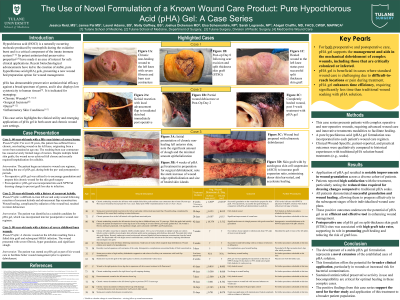
We conducted a seven-patient case series to assess outcomes following the topical application of a pHA gel formulation* to STSGs and/or the donor site, immediately post-procedure and during dressing change every 2-3 days. We monitored sites for related complications or adverse events. Clinical assessments quantified the time to complete re-epithelization (defined as >95% epithelization) and the percentage of graft take at 7 and 14 days. We also evaluated practical utility, specifically regarding application efficiency and containment.
Results:
Application of the pHA gel formulation* to 7 STSGs and 1 donor site yielded no reported complications or adverse events, consistent with pHA’s non-cytotoxic safety profile. The cohort exhibited an average 95% graft take at 7 days and 95-100% graft take at 14 days. Mean time to complete re-epithelization was 51 days. The gel formulation demonstrated clinical efficacy comparable to pHA solutions in reducing signs of microbial contamination, while also providing superior handling characteristics.
Discussion:
This series suggests that the pHA gel formulation* is compatible with freshly grafted skin and donor sites and offers distinct practical advantages over traditional aqueous soaks, including enhanced ease of application and reduced nursing burden.
Given wound bed susceptibility to critical colonization, the gel represents an effective therapeutic adjunct to prevent infection-mediated graft loss caused by high bioburden level, particularly by exudate-producing pathogens, without impeding the revascularization process.