
.jpg)
Clinical Research
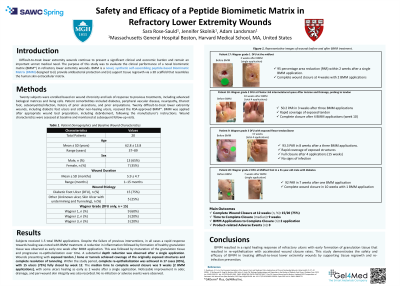
Given the magnitude of its clinical and economic burden, difficult-to-treat lower extremity wounds remain a serious unmet medical need. The purpose of this study was to evaluate the performance of a novel biomimetic matrix (BMM) in refractory lower extremity wounds. BMM is a synthetic self-assembling peptide matrix designed to (i) provide antibacterial protection via cationic charge and (ii) support tissue regrowth via a 3D scaffold that resembles the human skin extracellular matrix.
Methods: Twenty subjects were enrolled based on wound chronicity and lack of response to previous treatments, including advanced biological matrices. Patient comorbidities included diabetes, peripheral vascular disease, neuropathy, Charcot foot, osteomyelitis/infection, and history of prior amputations/ulcerations. Twenty difficult-to-treat lower extremity wounds, including diabetic foot ulcers and other non-healing ulcers, received the FDA-approved BMM*. BMM was applied after appropriate wound bed preparation, including debridement, following the manufacturer’s instructions. Wound characteristics were assessed at baseline and monitored during following visits.
Results: Subjects received 1-4 BMM applications total. Despite the failure of previous interventions, in all cases, a rapid response towards healing was noted with BMM treatment. A reduction in inflammation followed by granulation tissue presence was observed as early one week after BMM application. This was followed by maturation of the granulation tissue leading to re-epithelialization over time. A substantial depth reduction was observed after a single application. Wounds presenting with exposed tendon / bone or tunnels achieved coverage of the originally exposed structures and complete resolution of tunneling. Within the study period, complete re-epithelialization was achieved in 17 cases (85%), with 15 ulcers (75%) fully closed by week 12. The median time to complete wound closure was 8 weeks and 2 BMM applications, with some ulcers healing as early as 2 to 4 weeks after a single application. Noticeable improvement in odor, drainage, and peri-wound skin integrity was also recorded. No re-infection nor adverse events were observed.
Discussion:
BMM resulted in rapid healing response of refractory ulcers with early formation of granulation tissue that resulted in re-epithelization with accelerated wound closure rates. This study demonstrates the safety and efficacy of BMM in treating difficult-to-treat lower extremity wounds by tissue regrowth and re-infection prevention.