(CS-007) Limb Salvage of Large Pretibial Wound with Exposed Bone Using TheraGenesis
Friday, April 10, 2026
Sagar Gandhi, MD; James Patterson, BS/MS
Introduction: Distal lower extremity soft-tissue defects are difficult to manage secondary to limited soft-tissue coverage, marginal vascularity, and prevalence of exposed bone, which are further amplified in elderly patients with comorbidities like diabetes and peripheral arterial disease (PAD). Advanced treatment options include bioengineered templates, negative pressure therapy, fasciocutaneous/myocutaneous flaps, split-thickness skin grafts (STSG), and dermal regeneration templates intended to convert non-graftable wounds into vascularized granulation beds capable of supporting split-thickness skin grafts (STSG). Prior literature demonstrates improved wound bed preparation and reduced need for flap-based reconstruction when dermal matrices are used in a staged approach to prepare for STSG. This case describes successful use of Theragenesis to achieve granulation over exposed tibia in a complex pretibial wound.
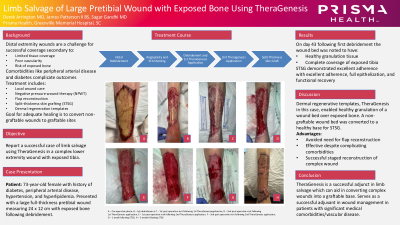
Methods: A 73-year-old woman with diabetes, PAD, hypertension, and hyperlipidemia presented with a 24 × 12 cm full-thickness pretibial wound with exposed tibia. Management included initial operative debridement, followed by angioplasty and stenting of high-grade distal superficial femoral artery stenosis one week later. Cleanse Choice™ negative-pressure wound therapy (NPWT) was applied. After two weeks, repeat excisional debridement and the first application of Theragenesis were performed. A subsequent debridement with re-application of Theragenesis occurred two weeks later. Serial NPWT and clinical monitoring guided progression toward definitive reconstruction and STSG 6 weeks after initial treatment.
Results: Forty-three days following initial debridement, the wound demonstrated robust granulation tissue with complete coverage of previously exposed tibial bone. A split-thickness skin graft harvested from the right thigh was placed. The graft exhibited excellent adherence and near-complete take without postoperative complications. Despite the challenging nature of this wound, the patient achieved full epithelialization and functional recovery.
Discussion: This case demonstrates the effectiveness of Theragenesis as part of a staged reconstruction protocol to aid in coverage and formation of granulation tissue of threatened areas with exposed bones, even in an elderly patient with multiple comorbidities. Dermal regeneration matrices can reliably convert compromised wound beds into graft-ready surfaces, reducing reliance on flap reconstruction, and optimizing outcomes in limb salvage settings.

.jpg)