
.jpg)
Clinical Research
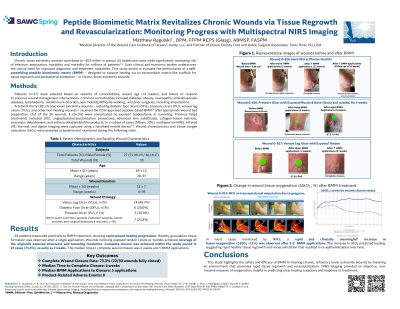
Chronic lower extremity wounds contribute to >$25 billion in annual US healthcare costs while significantly increasing risk of infection, amputation, morbidity and mortality for millions of patients. Such clinical and economic burden underscores the critical need for improved diagnostic and treatment modalities. This study aimed to evaluate the performance of a self-assembling peptide biomimetic matrix (BMM) – designed to support healing via an extracellular matrix-like scaffold for tissue regrowth and antibacterial protection – in chronic lower extremity wounds.
Methods:
Patients (N=27) were selected based on severity of comorbidities, wound age, and failure to respond to previous wound management interventions. A total of thirty (30) chronic lower extremity wounds – including diabetic foot ulcers, pressure ulcers, venous leg ulcers, and other non-healing wounds – received the FDA-approved peptide-based BMM* after appropriate wound bed preparation. In a subset of cases (fifteen), multispectral Near-Infrared Spectroscopy (NIRS), infrared (IR) thermal, and digital imaging were captured using a handheld mobile device**. Wound characteristics and tissue oxygen saturation (StO₂) were assessed at baseline and monitored during following visits.
Results:
All patients responded positively to BMM treatment, showing rapid wound healing progression. Healthy granulation tissue formation was observed after a single application. Wounds involving exposed tendon / bone or tunnels achieved coverage of the originally exposed structures and tunneling resolution. Complete closure was achieved within the study period in 22 cases (73%), as early as 2 weeks. The median time to complete wound closure was 6 weeks and 5 BMM applications. In most cases monitored by NIRS, a rapid and clinically meaningful increase in tissue oxygenation (ΔStO₂ >11%) was observed after BMM treatment (only one case showed a slight StO₂ reduction). The increase in StO₂ predicted healing, suggesting rapid healthy tissue regrowth and revascularization that resulted in re-epithelialization over time. Other important clinical observations included improvement in drainage and peri-wound skin integrity. No adverse events were observed.
Discussion:
This study highlights the safety and efficacy of BMM in treating chronic, refractory lower extremity wounds by fostering an environment that promotes rapid tissue regrowth and revascularization. NIRS imaging provided an objective, non-invasive measure of oxygenation, helpful in predicting ulcer healing trajectory and response to treatment.