
.jpg)
Clinical Research
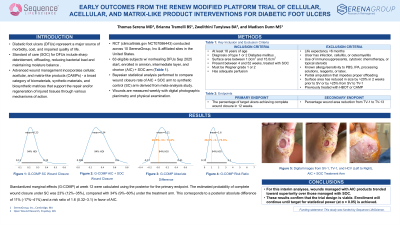
Diabetic foot ulcers (DFUs) represent a major source of morbidity, cost, and impaired quality of life. Although standard of care (SOC) remains essential, many ulcers fail to progress toward closure, prompting increased use of placental-derived biologic therapies. Cellular, acellular, and matrix-like products (CAMPs) provide extracellular matrix components and bioactive signals that may address the underlying biological deficits of chronic DFUs. The RENEW trial employs a novel, multicenter, prospective randomized modified platform design that evaluates multiple CAMP-based interventions versus matched controls within a framework that allows only one of up to five potential products to be active and enrolling at a time.
Methods: In this ongoing study, participants are randomized to the currently active CAMP arm, amnion, intermediate layer, and chorion (AIC) plus SOC, within the five treatment arm platform structure. Although the full analysis will ultimately utilize matched controls from the U.S. Wound Registry, this interim evaluation is limited to within-arm percent area reduction (PAR) over up to 9 weeks of application as an early indicator of wound trajectory. Bayesian hierarchical modeling was used to estimate PAR patterns and quantify uncertainty while data accrual continues.
Results:
Interim Bayesian modeling indicates that the AIC plus SOC arm demonstrates early PAR values of approximately 86.3% (Credible Interval: 79.0%-92.8%). As expected at this stage, individual variability is observed, and posterior distributions reflect the evolving nature of data within an ongoing platform trial. These preliminary PAR patterns reflect early wound trajectory signals for the active intervention; no comparative conclusions can be drawn until all study phases and matched-control analyses are complete.
Discussion: Interim findings from RENEW suggest that the AIC plus SOC arm may be associated with early wound size changes as reflected by PAR. These observations remain preliminary and will require confirmation as additional subjects complete follow-up and subsequent products undergo evaluation. Continued platform-based investigation will enable more definitive comparative assessment across CAMP interventions and may ultimately guide their integration into DFU care.