
.jpg)
Case Series/Study
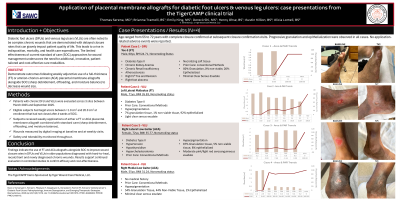
Herein, 4 subjects with chronic DFUs and VLUs evaluated across 3 sites between March 2025 and September 2025 are presented. Offloading was provided to DFU patients with a removable walker boot. Subjects had target ulcers between >1.0 cm2 and 20.0 cm2 at enrollment that had not closed after 4 weeks of SOC. Subjects received weekly applications of either a full-thickness (FT1) or amnion-chorion-amnion (ACA2) placental membrane allograft combined with standard care (sharp debridement, offloading, and moisture balance) in an ongoing randomized controlled modified platform trial. Subjects were followed until study end or 100% wound closure, per physician discretion.
Results: There were 3 male patients and 1 female patients evaluated, with an age range of 55 – 72 years. The baseline wound for the DFU patient was 1.9 cm²,and 2.5, 3.6, and 6.5 cm² (mean 3.6; SD 2.1) for VLU patients. Complete closure was achieved at Weeks 1, 4, 6, and 7; closures were confirmed at a subsequent closure confirmation visit. Progressive granulation and epithelialization were observed in all cases. No product-related adverse events were reported.
Discussion:
These case presentations demonstrate the potential of FT and ACA allografts alongside SOC to improve wound closure rates for DFUs and VLUs within older populations diagnosed with hard-to-heal, recalcitrant and newly diagnosed chronic wounds. These results highlight the impact of placental allografts and their supportive role in delivering timely, effective wound care across populations. Additionally, the results support the need for continued clinical studies which confirm product-related wound care benefits and the potential for reducing overall healthcare costs.