
.jpg)
Case Series/Study
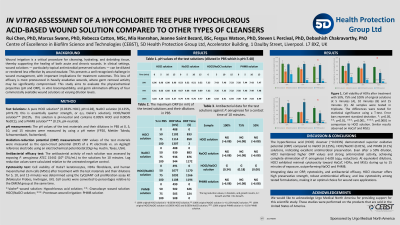
Wound irrigation is a critical procedure for cleansing, hydrating, and debriding tissue, thereby supporting the healing of both acute and chronic wounds. In clinical practice, however, the effectiveness of wound solutions—particularly topical antiseptics—can be reduced by dilution from wound exudate. This loss of efficacy is most pronounced in heavily exudative wounds, where antiseptic activity may be significantly compromised. This study aimed to evaluate the physicochemical properties (pH and ORP), in vitro biocompatibility, and antibacterial preservative efficacy of four commercially available wound solutions at varying dilution levels. Oxidation Reduction Potential (ORP) is a key measure of an antimicrobial’s key antimicrobial preservative property.
Methods:
The wound solutions tested included hypochlorous acid (HOCl) cleanser solution (~0.033%, pH 4.0) *, 0.125% sodium hypochlorite (NaOCl, pH 9.80) *, a combined solution of 0.01% HOCl/NaOCl (pH 7.0)*, and 0.1% polyhexanide (PHMB, pH 6.7) *. Each was assessed at three concentrations—100%, 75%, and 50%—for pH and oxidation-reduction potential (ORP), cytotoxicity on HaCaT keratinocytes, HDFa fibroblasts, and mesenchymal stem cells (MSCs), as well as antibacterial activity against Pseudomonas aeruginosa.
Results:
The HOCl cleanser solution exhibited higher ORP values compared to NaOCl, HOCl/NaOCl, and PHMB, indicating strong oxidative potential and excellent stability even after dilution. Remarkably, the HOCl solution retained strong antimicrobial efficacy even at 50% dilution, as evidenced by the complete elimination of P. aeruginosa ( >5.78 Log₁₀ reduction). At equivalent dilutions, the HOCl-based wound solution exhibited little to no cytotoxicity toward HaCaT, HDFa, and MSCs during up to 15 minutes of exposure, showing lower cytotoxicity compared to NaOCl and PHMB solutions.
Discussion:
This study indicated that a hypochlorous acid cleanser solution (~0.033%, pH 4.0) offered the greatest preservative strength, strongest antimicrobial activity, and lowest cytotoxicity among the tested formulations.