
.jpg)
Case Series/Study
Bacterial biofilms in wounds create substantial therapeutic challenges by forming protective extracellular matrices that dramatically reduce antimicrobial efficacy. Wound cleansing solutions can provide biofilm disruption without requiring prolonged antimicrobial activity, while antimicrobial gels often offer prolonged antibacterial effects but limited penetration through intact biofilm structures. This study addresses how synergistic combination therapy with sequential applications of wound solutions and antimicrobial gels can overcome these limitations and enhance clinical outcomes.
Methods:
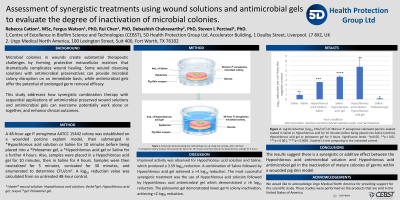
A 48-hour P. aeruginosa AATCC 15442 biofilm was established on a wounded porcine explant model, then submerged in *Hypochlorous acid solution or Saline for 10 minutes before being placed into a *Poloxamer gel, a *Hypochlorous acid gel or Saline for a further 4 hours. Also, samples were placed in Hypochlorous acid gel for 10 minutes, then in Saline for 4 hours. Samples were then neutralized for 5 minutes, sonicated for 30 minutes and enumerated to determine CFU/cm2. A log10 reduction value was calculated from an untreated 48-hour control.
Results:
Saline/Saline demonstrated marginal antimicrobial activity, achieving < 1 log10 reduction. Improved activity was observed for Hypochlorous acid solution and Saline, which produced a 3.59 log10 reduction. A combination of Saline followed by Hypochlorous acid gel achieved a >4 log10 reduction. The most successful synergistic treatment was the use of Hypochlorous acid solution followed by Hypochlorous acid gel, which demonstrated a >6 log10 reduction. The poloxamer gel demonstrated lower biofilm inactivation, achieving < 2 log₁₀ reduction.
Discussion:
The results suggest there is a positive combined synergistic effect between the Hypochlorous acid antimicrobial solution and the hypochlorous acid antimicrobial gel in the inactivation of mature biofilms within a wounded pig skin model.