(CS-118) Limb Salvage Using Hypochlorous Acid Treatment in Venous Leg Ulcer Case
Friday, April 10, 2026
Douglas Le, MS; Kerry Thibodeaux, MD FACS CWSP FACCWS FAPWCA – The Wound Treatment Center at Opelousas General Hospital
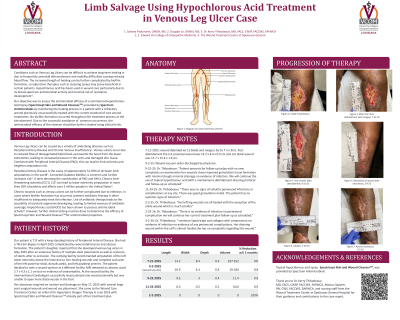
Introduction: Our patient has a long-standing history of Peripheral Arterial Disease with a Tib-Fem Bypass in April 2025 complicated by wound dehiscence and abscess formation. The patient’s daughter reported that she developed venous leg ulcers in May 2025. The outlying facility recommended amputation of the left lower extremity above the knee due to non-healing wounds and the patient decided to seek a second opinion in Lafayette. MRI detected an abscess sized 2.7 x 4.3 x 1.1 cm but no evidence of osteomyelitis. At the second facility the Interventional Cardiologist successfully revascularized one vessel proximally but was unable to open up more distal vessels in the foot. Her abscesses required an incision and drainage on May 17th with several large post-surgical wounds and wound vac placement. She came to the Wound Care Treatment Center on referral for Hyperbaric Oxygen Therapy in June 2025.
Methods: After discharge from the previous facility, she was referred to outpatient hyperbaric therapy at the Wound Clinic of Opelousas in May 2025. She was approved for the use of several therapies, including negative pressure therapy, hyperbaric therapy, and Bilayered Skin Substitute*. The Hypochlorous Acid** product was used to clean her left leg wounds at each visit and at home. Several areas of necrotic tissue were noted on left toes and left medial thigh, which were removed via excisional debridement three times in clinic by the physician.
Results: After her most recent debridement the LLE proximal wound was 8.2 x 2.5 x 0.3 cm. Her most recent measurements on 12-8-2025 were: LLE proximal 4.5 x 1 x 0.3 cm. She has been treated by the clinic for multiple wounds but her LLE proximal wound was decided to be the focus of this case due to a Bilayered Skin Substitute* product also utilized starting on 10-13-2025 to the LLE distal wound and not the LLE proximal wound.
Discussion: Due to this patient's critical limb ischemia and amputation recommended by a different facility, her outcome of salvaging the limb far exceeds expectations. This result was facilitated in part by the Hypochlorous Acid** Spray used during visits and at home to clean her wounds along with Hyperbaric Oxygen Treatment.

.jpg)