
.jpg)
Laboratory Research
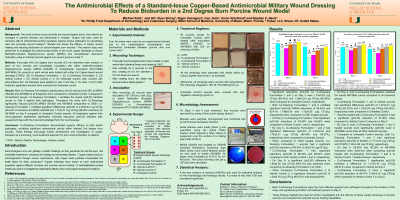
The most common burns clinically are second-degree burns, that need to be managed to prevent infection.1 Copper has been used for centuries to treat wounds due to its’s antimicrobial activity against various pathogens. 2,3 Studies have also shown copper can enhance wound healing and reduce bioburden on second-degree burn wounds.4 The present study was performed to investigate the antimicrobial activity of two novel copper dressings to reduce Methicillin-resistant Staphylococcus aureus (MRSA) and Acinetobacter baumannii bioburden using an infected second degree burn wound porcine model.5,6
Methods:
Forty eight (48) 2nd degree burn wounds (8.5 mm diameter) were created on each of four animals and immediately inoculated with either methicillin-resistant Staphylococcus aureus (MRSA USA300) or Acinetobacter baumannii ATCC19606 (AB19606). Six wounds on each animal were treated with either (A) Copper-based wound dressings [CWD]*, (B) Cu-Dressing Formulation 1, (C) Cu-Dressing Formulation 2, (D) Vehicle Control 1, (E) Vehicle Control 2, or (F) Untreated Control, then covered with polyurethane film. All dressings were applied on day 0 and day 3. On days 3 and 6 after treatment application wounds were recovered for bioburden counts.
Results:
Both Cu-Dressing Formulations significantly (p ≤0.05) reduced over 95% of MRSA USA300 and AB19606 at all timepoints when compared to Untreated Control. Compared to all treatment groups, Cu-Dressing Formulation 1 exhibited the lowest (p≤0.05) bacterial counts on Day 6 against both pathogens. Throughout the study both Cu-Dressings significantly reduced (p≤0.05) MRSA USA300 and AB19606 comparative to CWD. Cu-Dressing Formulation 1 exhibited significant differences (p≤0.05) of 2.25±0.44 Log CFU/g (99.44% of reduction) for MRSA USA300 and 1.71±0.07 Log CFU/g (98.06% reduction) for AB19606 on day 6 compared to Untreated Control wounds. All treatments against both microorganisms established significative microbial reductions (p≤0.05) between both assessment days with the most acknowledged from the Cu-Dressings.
Discussion: Cu-Dressing Formulations demonstrated superior efficacy on both tested pathogens, exhibiting significant antimicrobial activity within infected 2nd degree burn wounds. These findings encourage further development and investigation of copper therapies as a promising, novel treatment approach for burn wound infections in patients.