(CR-028) Hypochlorous Acid–Mediated Oxidative Debridement in Human Chronic Wound Tissue
Friday, April 10, 2026
Lauren Fernandez, BS – Research Associate, Dermatology, University of Miami; Sandra Predic, MS – Research Associate, Dermatology, University of Miami; Jelena Majanovic, PhD – Post-Doctorial, Dermatology, University of Miami; Hadar Lev-Tov, MD; Jose Jaller, MD – Physician, Dermatology, University of Miami; Irena Pastar, PhD – Principal Investigator, Dermatology, University of Miami
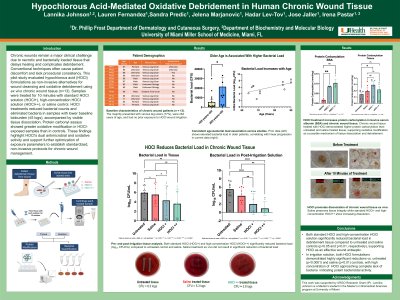
Introduction: Chronic wound care represents a major clinical challenge and imposes a substantial financial burden on healthcare systems. A major impediment to effective healing is the presence of necrotic and bacterial loaded tissue, whose removal is a critical therapeutic step. However, conventional debridement procedures are frequently associated with patient discomfort, lack standardized approach, and vary clinician-to-clinician. A stabilized hypochlorous acid (HOCl) solution has emerged as an alternative approach for wound cleansing and non-invasive removal of necrotic wound tissue. The objective of this pilot study was to evaluate the effect of HOCl solution on human chronic wound tissue ex vivo mimicking debridement.
Methods: Debridement specimens from chronic lower extremity ‑wounds (n=6) without clinical signs of infection, were collected and processed ex vivo. Samples were exposed for ten minutes HOCl standard solution, enhanced strength of HOCl solution, HOCl gel, and phosphate-buffered saline as the control. Macroscopic changes were documented photographically. Protein oxidation was quantified by protein carbonyl content using ELISA assay. Microbial burden was also evaluated by colony forming unit (CFU) quantification on blood agar under aerobic and anaerobic conditions up to 5 days.
Results: CFU analysis showed reduction of aerobic bacteria by up to 3 logs post all HOCl treatment (Welch’s t-test, p=0.03). The tissue that has lower bacterial load, 5 logs, HOCl treatments resulted in complete bacterial elimination. In addition to antimicrobial activity, we also observed mechanical dissociation of tissue post treatment. The preliminary experiment with bovine serum albumin treated with HOCl solutions suggests a stronger trigger in protein carbonyl levels than buffer controls.
Discussion: Ongoing work focuses on expanding sample numbers and optimizing tissue processing, protein normalization, and exposure conditions to clearly define how hypochlorous formulations influence oxidative debridement and bacterial burden in chronic wounds. These preliminary observations are consistent with the known antimicrobial activity of hypochlorous solutions in wounds and support optimization of the ex vivo platform to evaluate bioburden reduction and oxidative debridement by HOCl. As we continue enrollment, this framework is expected to yield more robust mechanistic data on how non-invasive bedside treatment with HOCl formulations could aid surgical debridement of chronic wounds.

.jpg)