(LR-012) The Antimicrobial Effects of a Standard-Issue Copper-Based Antimicrobial Military Wound Dressing to Reduce Bioburden in a Full Thickness Porcine Wound Model
Friday, April 10, 2026
Michael Solis, MBA – Sr. Research Associate 1, Dr. Phillip Frost Department of Dermatology & Cutaneous Surgery, University of Miami Miller School of Medicine; Ryan Strong, BS – Research Associate, Dr. Phillip Frost Department of Dermatology & Cutaneous Surgery, University of Miami Miller School of Medicine; Roger Cassagnol, BS – Research Assistant, Dr. Phillip Frost Department of Dermatology & Cutaneous Surgery, University of Miami Miller School of Medicine; Jie Li, PhD – Associate Professor, Dr. Phillip Frost Department of Dermatology & Cutaneous Surgery, University of Miami Miller School of Medicine; Aaron Strickland, PhD – VP R&D and Co-Founder, iFyber, LLC; Stephen Davis, BS – Research Professor, Dr. Phillip Frost Department of Dermatology & Cutaneous Surgery, University of Miami Miller School of Medicine
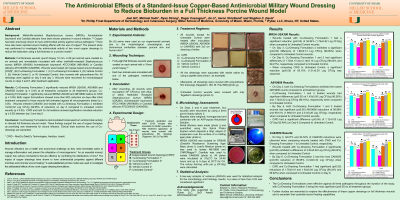
Introduction: Methicillin-resistant Staphylococcus aureus (MRSA), Acinetobacter baumannii and Candida albicans have been shown presence in wound infection. 1-3Copper has been previously shown to have antimicrobial activity against various pathogens.4 There have also been reported wound healing effects with the use of copper.5 The present study was performed to investigate the antimicrobial activity of two novel copper dressings to reduce the bioburden using a full thickness in a porcine model.6
Methods: Full thickness wounds (punch biopsy 10 mm, n=48 per animal) were created on six animals and immediately inoculated with either methicillin-resistant Staphylococcus aureus (MRSA USA300) Acinetobacter baumannii ATCC19606 (AB19606) or Candida albicans ATCC64550 (CA64550). Wounds were treated (A) Copper-based wound dressings [CWD]*, (B) Cu-Dressing Formulation 1, (C) Cu-Dressing Formulation 2, (D) Vehicle Control 1, (E) Vehicle Control 2, or (F) left untreated, then covered with polyurethane film. All dressings were applied on day 0 and day 3. Wounds were recovered for microbiological counts on days 3 and 6, after treatment application.
Results: Cu-Dressing Formulation 2 significantly reduced MRSA USA300, AB19606 and CA64550 burden (p ≤ 0.05) at all timepoints compared to all treatment’s groups. Cu-Dressing Formulation 1 significantly reduced MRSA USA300 and AB19606 relative to CWD (p ≤ 0.05). Both copper formulations showed more than 99% reduction six days after initial treatment compared to those wounds left untreated against all microorganisms tested (p ≤ 0.05).Wounds infected CA64550 and treated with Cu-Dressing Formulation 2 exhibited 3.24±0.32 Log CFU/g (99.95% of reduction) on day 6 compared to untreated control wounds (p ≤ 0.05).CWD and both Cu formulations showed significative microbial reduction (p ≤ 0.05) between day 3 and day 6.
Discussion: Cu-Dressing Formulations demonstrated broad-spectrum antimicrobial activity in infected full thickness wound model. These findings support the use of copper therapies as promising new treatments for wound infection. Clinical trials examine the use of Cu-dressings are warranted.

.jpg)