
.jpg)
Case Series/Study
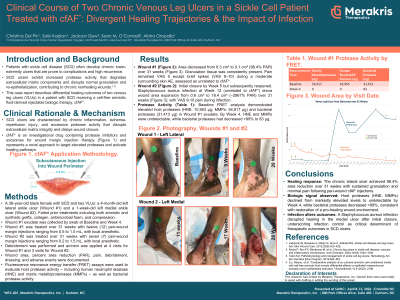
Sickle cell disease (SCD) is associated with chronic leg ulcers that are difficult to heal and prone to complications. Cell-free amniotic fluid (cfAF) may offer a therapeutic benefit and is being studied for the treatment of complex wounds. This case report describes two venous leg ulcers (VLUs) in a SCD patient that was treated with cfAF, highlighting distinct healing trajectories of each wound and influence of local infection.
A 38-year-old black female with SCD and venous insufficiency presented with two VLUs: a four-month-old left lateral ankle ulcer (Wound #1) and a one-week-old left medial ankle ulcer (Wound #2). Prior treatments included both amniotic and synthetic grafts, collagen, antimicrobial foam, and compression. Patient received cfAF into the wound margin at routine visits with standard wound care and debridement. Local anesthesia was applied as needed using either injectable or topical lidocaine spray. Wound area, percent area reduction (PAR), pain, debridement, dressing, and adverse events were documented over 19 weeks.
Wound #1 was treated over 19 weeks with nine cfAF injections. The wound decreased from 6.3 cm² to 1.5 cm², achieving a 76.2% PAR. Granulation tissue was observed consistently; pain was 0 at nearly all visits except transient spikes (VAS 9–10) coinciding with a moderate adverse event involving surrounding skin, assessed as unrelated to MTX-001. Regular debridement was performed, and amnion was used at three visits.
In this SCD patient, cfAF was associated with substantial improvement in chronic lateral ulcer, while healing of medial ulcer was severely disrupted by infection. These findings suggest that cAF may support healing in chronic wounds in the absence of infection. Further study is warranted to clarify role in high-risk ulcer populations.