
.jpg)
Practice Innovations
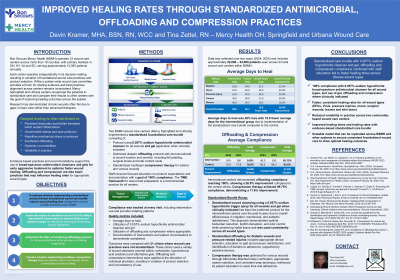
This experience demonstrates that consistent, protocol-driven wound care can significantly accelerate healing across multiple wound types. Over a three-year period, our two clinics achieved markedly faster days-to-healed compared to the system’s 23-clinic average—improving diabetic wounds by 15.5 days, pressure injuries by 29.5 days, traumatic wounds by 8 days, and venous ulcers by 14.5 days. Although arterial wound data showed variability due to a small number of longstanding cases, one clinic still outperformed the system by 18 days. Overall, an average improvement of 11.7 days to healed across all wound types illustrates that standardizing antimicrobial cleansing with 0.057% sodium hypochlorite, reinforcing offloading, and ensuring consistent compression use can meaningfully reduce healing times. This highlights the value of reducing practice variability, tracking provider adherence to interventions, and maintaining evidence-based protocols to drive better outcomes.
Discussion: “This experience shows that standardizing evidence-based wound care practices—such as consistent antimicrobial cleansing, appropriate offloading, and multilayer compression—can meaningfully accelerate healing across multiple wound types. By reducing practice variability and tracking provider adherence to key interventions, our clinics achieved faster days-to-healed than the system average in almost every wound category. The overall improvement of 11.7 days demonstrates that reliable processes, rather than isolated individual practices, are critical for achieving consistent and superior patient outcomes.