
.jpg)
Case Series/Study
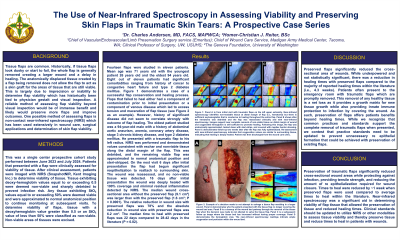
Traumatic skin flaps are often excised due to uncertainty about tissue viability, resulting in larger wounds and prolonged healing. Near-infrared spectroscopy (NIRS) offers a noninvasive, point-of-care method to assess tissue oxygenation and perfusion, potentially guiding flap preservation. Objective of this study was to evaluate whether NIRS can identify viable skin flap tissue for preservation and assess its impact on wound size and healing time compared with historical norms.
Methods:
A single-center prospective cohort study was conducted between June 2023–July 2024. Eleven patients (14 skin flaps) underwent NIRS imaging (SnaphotNIR, Kent Imaging, Calgary, Canada) after clinical assessment. Tissue with StO₂ ≥50% was preserved; nonviable tissue was debrided. Outcomes included wound size reduction and time to complete epithelialization. Statistical analysis used Wilcoxon signed rank tests.
Results:
Preserving viable flaps significantly reduced wound size: median cross-sectional area decreased from 9.1 cm² (IQR, 4.2–11.7 cm²) to 1.6 cm² (IQR, 0.9–2.9 cm²) (P = .0001), a median absolute reduction of 6.2 cm² (78%). Median healing time was 22 days (IQR, 21–41 days), compared with 28–42 days reported in the literature (P = .82). Although underpowered, findings suggest NIRS-guided preservation accelerates healing and minimizes tissue loss.
Discussion:
NIRS provides rapid, objective assessment of skin flap viability, enabling tissue preservation and reducing wound size. Reducing wound-healing time also has significant economic benefits. As of June 2024, a single visit to the aforementioned Wound Care Clinic costs about $200 to the patient or insurer. Cutting follow-up visits by one or two weeks could save $200–$400 per patient. Based on this study’s 11 patients, the roughly 2,200 specialty wound care clinics in the U.S., and a conservative estimate of one visit saved per patient, the annual national savings could reach at least $5 million. While larger, multicenter studies are needed, these results support incorporating NIRS into clinical workflows to improve outcomes and potentially reduce costs.