(CS-139) The Successful Use of Hypochlorous Acid Solution in the Non-Surgical Management of Giant Omphaloceles in Neonates
Friday, April 10, 2026
Stephen Almond, MD – general pediatric surgeon, surgery, Driscoll Children's Hospital; Mohammad Emran, MD – general pediatric surgeon, surgery, Driscoll Children's Hospital; Monica Ramirez, RN WCC – Wound Care RN, wound care, Driscoll Children's Hospital
Introduction: Giant omphalocele (GO) presents a significant challenge in neonatal care, characterized by a thin, translucent sac through which abdominal contents—including the liver and other delicate structures—are visible. Because the sac is fragile and highly susceptible to rupture, maintaining its integrity from birth through complete epithelialization is essential. Effective wound care plays a critical role in preventing infection, supporting sac maturation, and optimizing outcomes while awaiting staged closure.
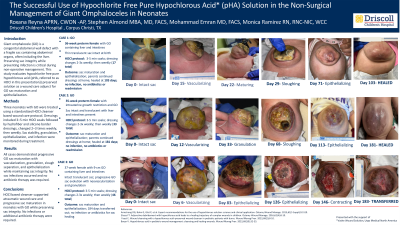
Methods: A standardized wound care protocol incorporating hypochlorous acid (HOCl) solution was implemented for neonates with GO. The protocol was used on two preterm neonates and one full-term neonate born with GO. In the early phase, the solution was applied gently to cleanse the fragile sac. As the sac matured and thickened, soft gauze was placed over the defect and the solution was applied over the gauze to achieve a controlled 3–5-minute soak. When granulation buds formed and the sac developed a slough-like layer, HOCl soaks continued, followed by gentle mechanical debridement of loosely adherent slough. A hydrofiber dressing and silicone border dressing were applied after each treatment, with dressing changes every 3–7 days depending on drainage, sac progression, and tolerance. Clinical responses—including sac stability, granulation, bioburden control, and infant tolerance—were monitored throughout hospitalization.
Results: Use of HOCl solution was associated with improved bioburden management, stable sac evolution, and favorable granulation without evidence of tissue irritation. The gentle cleansing properties and neutral pH supported atraumatic wound care, even in premature infants.
Discussion: Hypochlorous acid represents a safe and effective option in the non-surgical management of giant omphaloceles. Its use may reduce complications while awaiting staged closure. Further prospective evaluation is warranted.

.jpg)